
BLOG · Payments strategy
Interchange++ vs blended pricing: how to read a payment provider's quote
One month of card payments priced three ways, the EU rules on what your statement must show, and the lines to ask for before you sign.
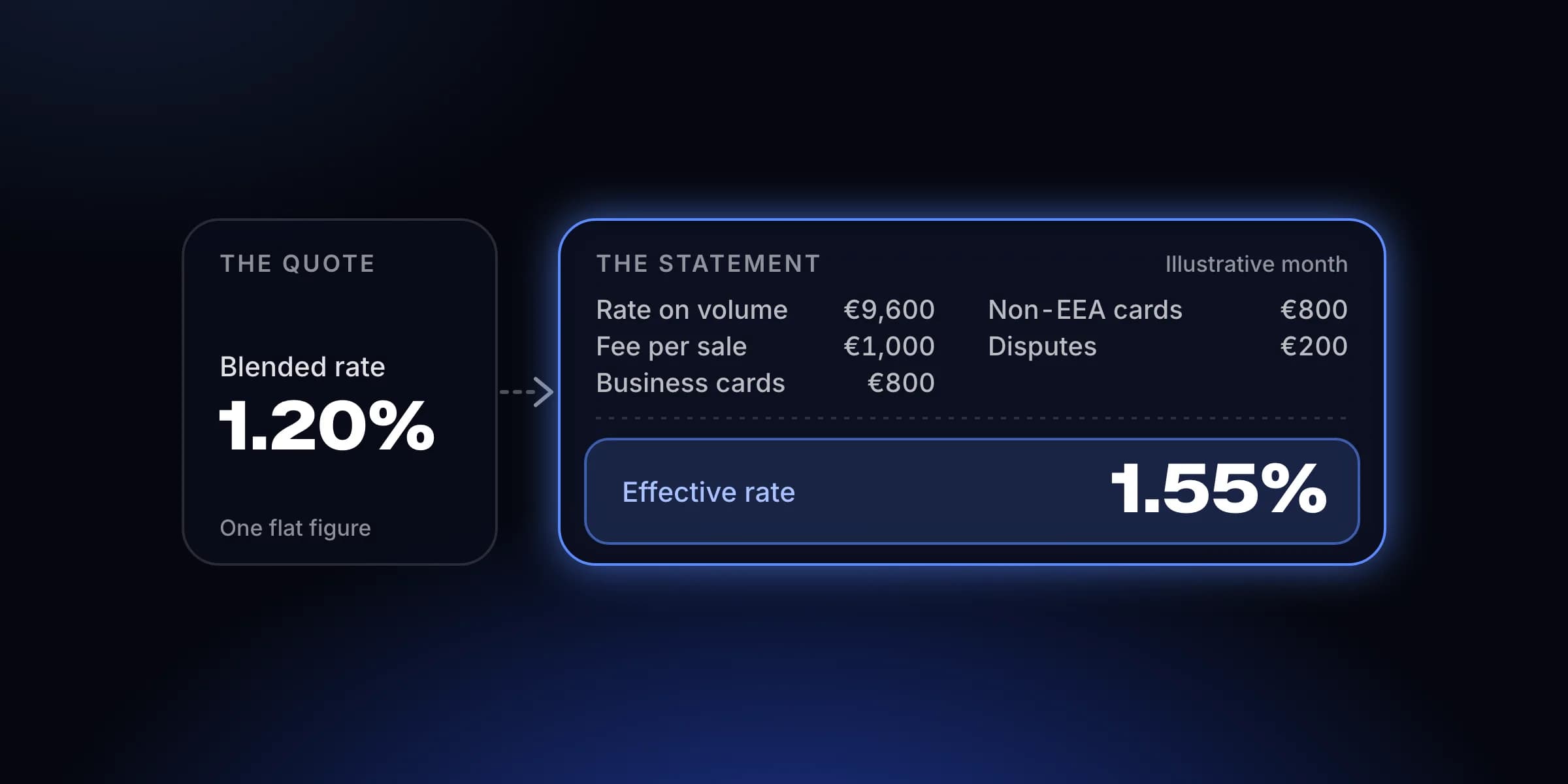
The quote said 1.20%. The first statement works out at 1.55%. Nobody lied: the gap between those two numbers is what interchange++ vs blended pricing is really about, and it is the reason two quotes that look a few tenths apart can end up thousands of euros apart over a year.
Short answer: blended pricing charges one rate for every card and keeps the difference on the cheap ones. Interchange++ (IC++) passes through what the card actually costs, interchange and scheme fees, and adds the provider’s markup on top. IC++ usually works out cheaper for merchants whose customers mostly pay with EEA consumer cards, because interchange on those cards is capped. Blended can win when your mix is heavy in expensive cards and the quote truly stays flat, which is rarer than it sounds.
Below is one month of payments priced both ways, plus the middle option, interchange plus. After that come the EU rules on what your provider has to show you, and the lines to ask for before you sign anything.
Blended, IC+ and IC++ in one paragraph each
Blended pricing is a single rate, sometimes with a fixed fee per sale, applied to every card: say 1.20% + €0.10. You know the price in advance. What you don’t see is that a debit card from a German bank costs the provider far less than a business credit card from the US, and the blended rate is set to cover both.
Interchange plus (IC+) passes the interchange fee through at cost and bundles everything else into one markup: say interchange + 0.40% + €0.10. The markup includes the scheme fees, so you can’t see how much of it is Visa’s or Mastercard’s and how much is your provider’s margin.
Interchange plus plus (IC++) separates all three: interchange, then scheme fees, then the provider’s own markup. It is the most transparent of the three and the hardest to forecast, because your monthly cost moves with the cards your customers happen to use.
What EU law says about how you’re billed
Most guides on this topic are written for the US market. In the EU, the Interchange Fee Regulation, Regulation (EU) 2015/751, sets the frame, and it gives you more say than most quotes suggest.
Three parts of it matter when you compare quotes:
Itemised charging is the default. Article 9 requires acquirers to offer and charge merchant service charges itemised by card category and brand, with interchange and scheme fees shown separately. Blended pricing is something you have to ask for in writing. If a provider only offers a blended rate, it is worth asking why.
You are entitled to the detail. Article 12 says that after each transaction your provider must tell you the merchant service charge and the interchange fee separately. With your explicit consent, that information can be grouped by brand, card category and interchange rate, and your contract can provide for it at least monthly.
The caps are narrower than people think. Interchange on consumer cards issued and used in the EEA is capped at 0.2% for debit and 0.3% for credit. Business cards, three-party schemes and cards issued outside the EEA are outside those caps. Neither scheme fees nor the provider’s markup is capped at all.
Cards issued outside the EEA have their own ceilings: 0.2% and 0.3% when the card is present, 1.15% for debit and 1.50% for credit online. They come from commitments Visa and Mastercard gave the European Commission, which made them legally binding in 2019. In 2024 the two schemes voluntarily extended them until November 2029. Either way, they sit outside the regulation itself.
Business cards are where the numbers jump. Visa’s published intra-EEA tables, for example, list business and corporate cards online at between about 1.65% and 2.00%.
One month under interchange++, IC+ and blended pricing
Here is a realistic month for an online merchant selling across the EU: 10,000 card payments averaging €80, so €800,000 in volume. The card mix is 60% EEA consumer debit, 20% EEA consumer credit, 10% business cards and 10% consumer cards issued outside the EEA (half debit, half credit), all online.
The interchange is the same under IC+ and IC++, because both pass it through:
EEA consumer debit €480,000 at the 0.2% cap | €960 |
EEA consumer credit €160,000 at the 0.3% cap | €480 |
Business cards €80,000 at an assumed 1.80% | €1,440 |
Non-EEA debit, online €40,000 at 1.15% | €460 |
Non-EEA credit, online €40,000 at 1.50% | €600 |
Interchange for the month | €3,940 |
Now the three quotes. The markups are illustrative, but they are shaped like the price lists providers publish:
IC++: interchange, plus scheme fees (we assume 0.10% of volume), plus a markup of 0.20% + €0.10 a sale.
IC+: interchange, plus a single markup of 0.40% + €0.10 a sale.
Blended: 1.20% + €0.10 a sale, with 1% more on business cards and cards from outside the EEA. Flat quotes very often carry an uplift like this in the small print.
All three pay the same €200 for ten disputes at €20 each.
Interchange++ | Interchange plus | Blended | |
|---|---|---|---|
Interchange | €3,940 | €3,940 | inside the rate |
Scheme fees | €800 | inside the markup | inside the rate |
Percentage markup or rate | €1,600 | €3,200 | €9,600 |
Fee per sale, €0.10 | €1,000 | €1,000 | €1,000 |
Uplift on business and non-EEA cards | none | none | €1,600 |
Disputes | €200 | €200 | €200 |
Total for the month | €7,540 | €8,340 | €12,400 |
Effective rate | 0.94% | 1.04% | 1.55% |
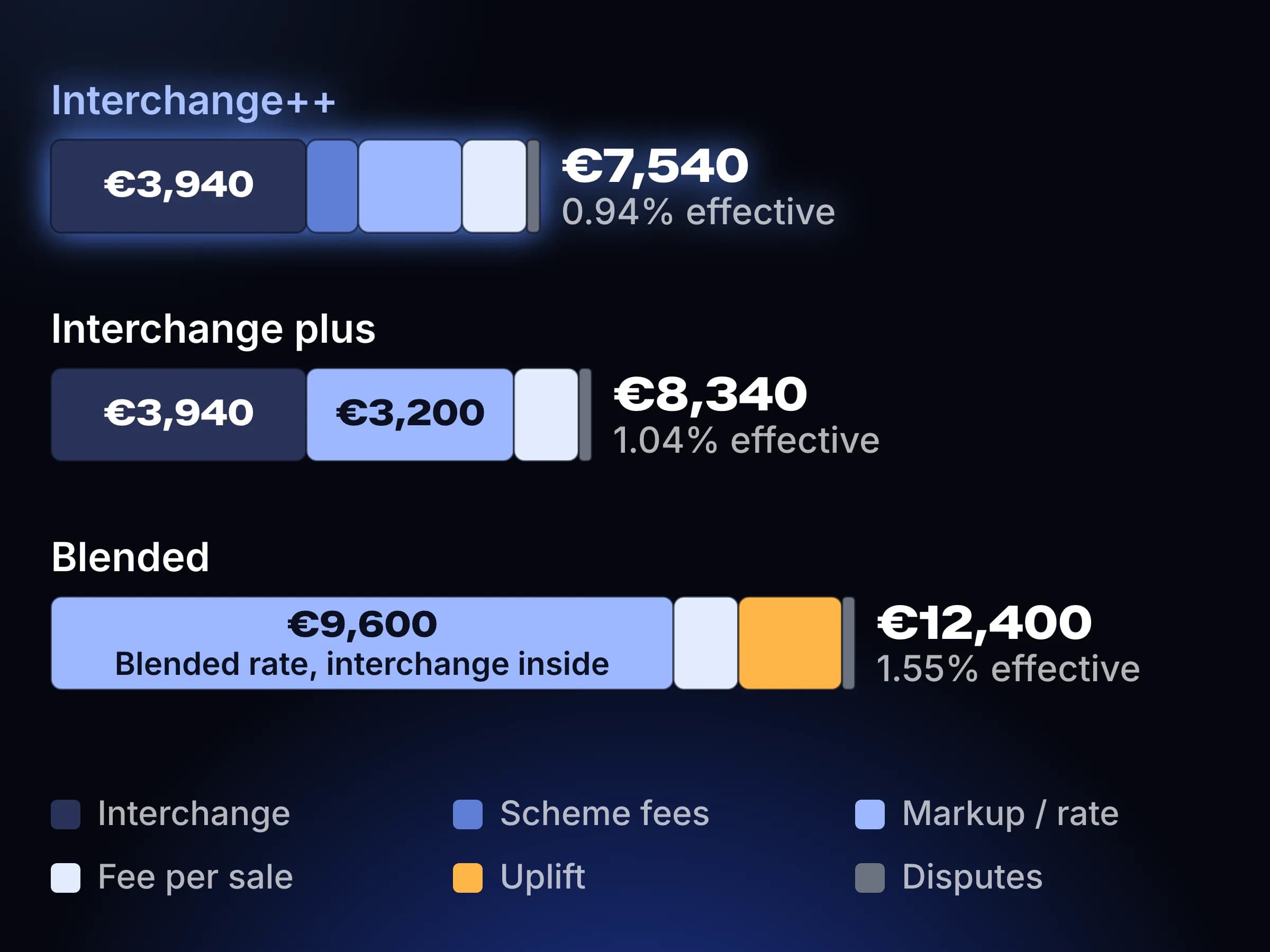
The blended quote headlined at 1.20% and cost 1.55%. The IC++ quote’s markup looked like 0.20% and the month cost 0.94%, because interchange and scheme fees sit underneath it.
Two caveats before you lift these numbers. Scheme fees are the weakest assumption here: there is no public schedule for the EU, and real scheme fees vary by scheme, country and card type, usually more for cards from outside the EEA. And every model can be made to look cheapest by changing the mix and the markups, which is exactly why you should price your own month, not a provider’s example.
Why the effective rate never matches the quote
Your effective rate is the total you paid in fees divided by the total you took in card payments, for the same period. It drifts away from the quoted rate for four reasons.
Your card mix moves. More business customers, a campaign in the US, a shift towards premium credit cards: under IC++ each of these changes your cost the same month. Under blended pricing the provider carries that risk, and prices it in.
Fixed fees weigh more on small payments. €0.10 is 0.125% of an €80 payment and 0.5% of a €20 one. A business with a low average basket can pay well above the headline rate without any single fee looking large.
Some fees live outside the rate. Disputes, currency conversion, refunds where the original fee is kept, authorisation fees on declined attempts, monthly minimums. One provider’s public price list adds 2% when currency is converted, and charges €20 per dispute.
Uplifts hide in the small print. Premium, business and international cards often carry a surcharge on top of a blended rate. If the quote doesn’t mention them, ask in writing whether they exist.
The lines to ask for on every quote
Before you compare two offers, get both into the same shape. These are the questions that make a quote comparable:
Is interchange passed through at cost, per card category? Under Article 9 you can ask for it to be shown separately.
Are scheme fees itemised, or bundled into the markup? If bundled, is there a cap on how much they can rise?
What is the markup, as a percentage and as a fixed fee per sale, stated separately?
Are declined and failed attempts charged?
On a refund, is the original fee returned, and is there a separate refund fee?
What does a dispute cost, and is it charged when you win?
If you take payments in other currencies, who sets the exchange rate and what is the markup?
When is money settled to you, is any of it held as a rolling reserve, and what are the minimum monthly fee, the contract term and the exit terms?
A provider that answers all eight on one page is easy to compare. One that needs a call to explain its price is telling you something too.
How to read your own statement
You can work out your real cost from statements you already have. Take the last three months, because a single month can be distorted by a campaign or a holiday.
Add up every fee on the statement, including the ones listed outside the main table, and divide by your card volume for the same months. That is your effective rate. Then ask your provider for the per-category breakdown Article 12 entitles you to: interchange and merchant service charge by card type. Set the interchange lines next to the caps. If your EEA consumer debit interchange is above 0.2%, ask why.
The breakdown also shows your real mix, which is the input every quote depends on. A provider pricing your business on an assumed mix of 90% consumer debit, when yours is 70%, is quoting someone else’s business.
Which model suits which business
IC++ suits most merchants with meaningful volume whose customers pay mainly with EEA consumer cards. The caps keep those cards cheap, and IC++ lets you keep the saving. It also makes the cost of each card type visible, which is useful when you decide where to steer customers.
Blended suits businesses that value a predictable number over the lowest one, and smaller merchants who can’t negotiate a markup anyway. The trade is clear: you pay for the certainty.
Blended wins on price only in one situation: your mix is heavy in expensive cards and the flat rate genuinely stays flat. A B2B seller whose volume is half business cards and half non-EEA credit cards would pay about 2.08% under the IC++ quote above, against 1.33% under a truly flat 1.20% + €0.10. Few flat quotes survive that mix. Providers either price those cards separately from the start, or re-quote when they see your statements.
Where Pay by Bank changes the maths
Everything above is about cards. Part of your volume may not need to be.
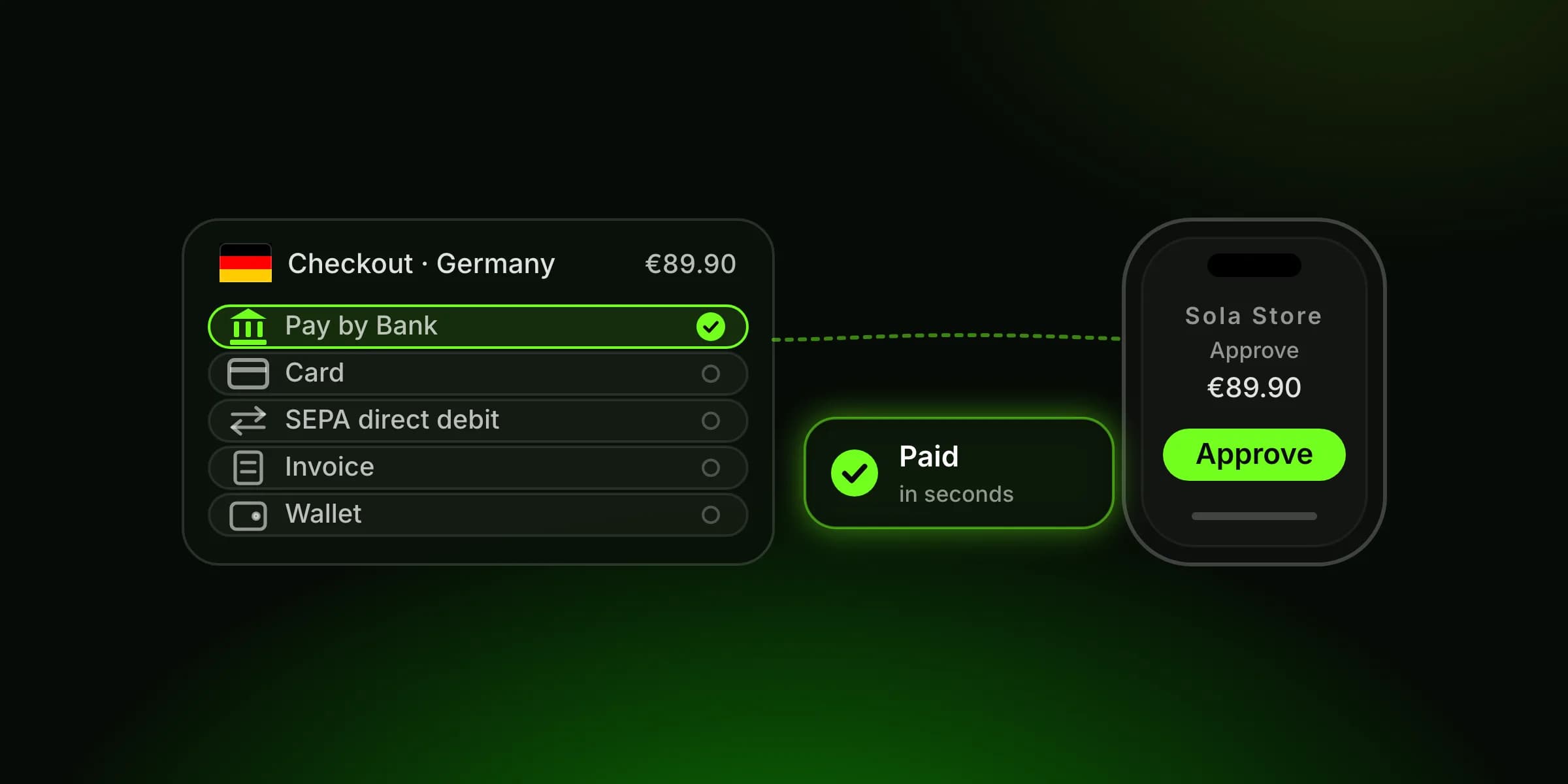
A Pay by Bank payment moves money from the customer’s bank account to yours, approved in their banking app. There is no card in the flow, so there is no interchange and no scheme fee for that payment. You pay your provider’s fee for the bank payment, and the card costs of the customers who stay on cards don’t change. We compare the two line by line, at three basket sizes, in Pay by Bank vs card payments.
The practical question is how much of your volume would move, and at what basket size the move pays for itself. That depends on your customers’ countries and banks, and on what you sell.
Frequently asked questions
What is interchange++ pricing?
Interchange++ (IC++) is a card pricing model with three separate parts: the interchange fee paid to the card issuer, the scheme fee paid to Visa or Mastercard, and the payment provider’s own markup. Your statement shows each one, so your cost follows the cards your customers actually use.
Is interchange++ cheaper than blended pricing?
For most EU merchants whose customers pay with EEA consumer cards, yes, because interchange on those cards is capped at 0.2% for debit and 0.3% for credit. Blended pricing can come out cheaper when most of your volume is business cards or cards issued outside the EEA, as long as the flat rate really stays flat.
How do I calculate my effective rate?
Add up every fee you paid for card payments in a period, including dispute, refund and currency fees, and divide by your total card volume for the same period. Multiply by 100 for a percentage. Use three months rather than one, so a campaign or a holiday doesn’t skew it.
Are interchange fees capped in the EU?
Yes, but only for consumer cards issued and used in the EEA: 0.2% of the payment for debit and 0.3% for credit, under Regulation (EU) 2015/751. Business cards and three-party schemes are not capped. Consumer cards issued outside the EEA are held to separate ceilings that Visa and Mastercard committed to with the European Commission.
What fees are not included in a quoted card rate?
Often: dispute fees, currency conversion markups, fees on declined or failed attempts, refunds where the original fee is kept, surcharges on premium, business or international cards, and monthly minimums. Ask for each in writing before you compare quotes.
Where Sola fits
Sola runs card payments over Visa and Mastercard connections we bring and maintain, so there is no acquiring contract for you to negotiate. Cards and Pay by Bank sit on one integration, in one dashboard and one settlement file, and routing moves payments between your methods on cost and approval. Payment services are provided by licensed partners. We don’t publish rates in articles. Send us your statements and we come back with a written comparison against your current setup. More on our card processing.
Sources
Regulation (EU) 2015/751 on interchange fees for card-based payment transactions, EUR-Lex, 29 April 2015
Study on the application of the Interchange Fee Regulation, Copenhagen Economics and EY for the European Commission, March 2020
Fees and interchange, Visa in Europe, Visa, intra-EEA tables
Merchant interchange rates, Europe, Mastercard
Commission accepts commitments by Mastercard and Visa on inter-regional interchange fees, Bird & Bird summary, May 2019
Visa and Mastercard extend inter-regional fee caps in the EEA, FStech, July 2024
Regulation (EU) 2019/518 on cross-border payments and currency conversion charges, EUR-Lex, 19 March 2019
Send us a quote or a statement
We price it line by line and show your real effective rate, in writing, usually within two working days.
Get it priced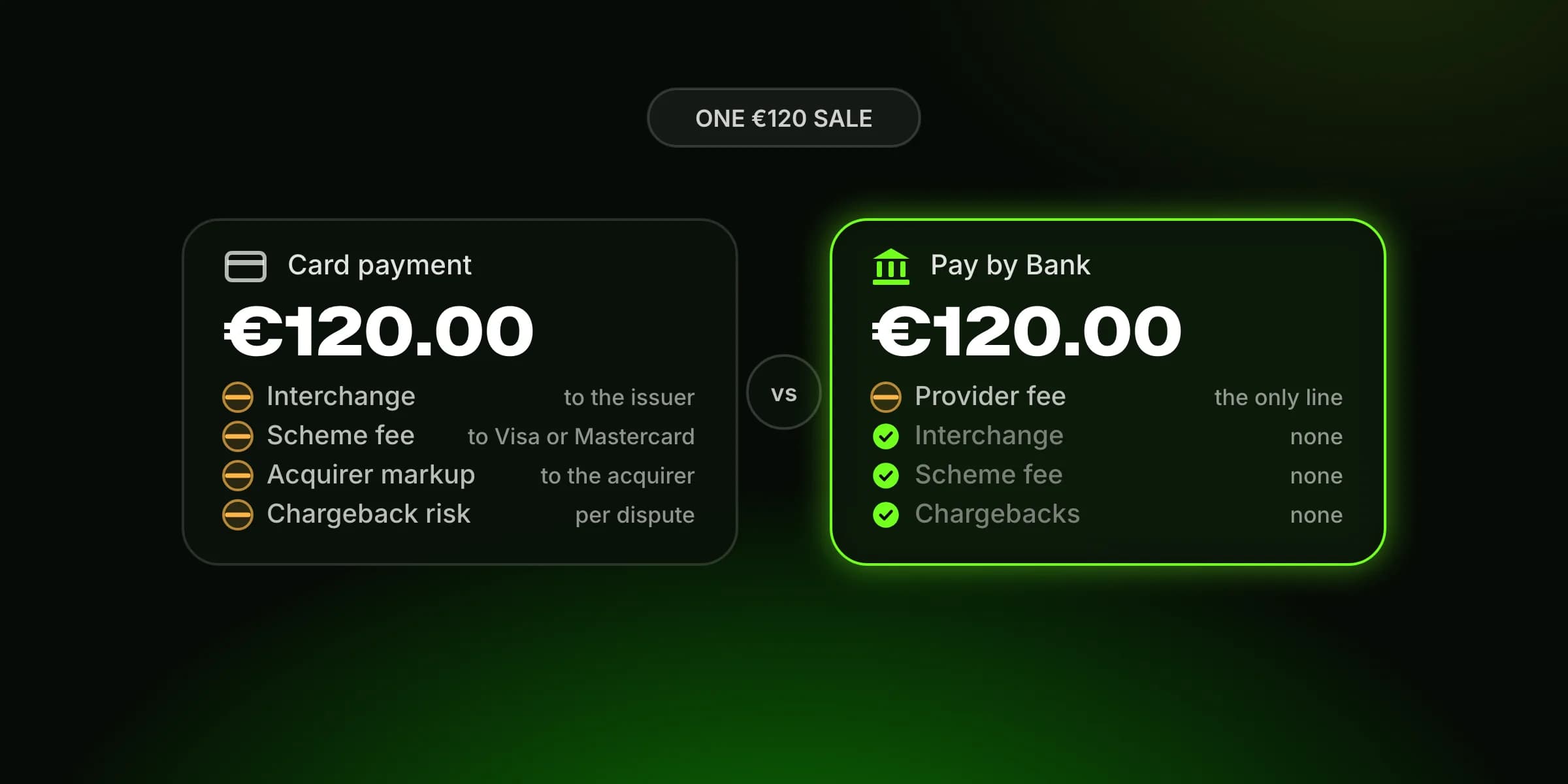
Payments strategy
Pay by Bank vs card payments: what each sale really costs
NEWSLETTER
One email a month. No fluff.
New articles on Open Banking, card costs, routing and regulation — straight to your inbox. Unsubscribe in one click.