
Payments strategy
BLOG · Payments strategy
How German shoppers actually pay online, why cards come fourth, what happened to giropay, where Wero stands, and a checkout set-up that fits.
If you know checkouts in the UK or the Netherlands, the payment methods Germany expects will surprise you. Cards come fourth. Paying after delivery, by invoice, is nearly as common as PayPal. And the country’s own bank payment brand, giropay, closed at the end of 2024.
Short answer: in 2025, PayPal took 28.7% of online revenue in the EHI Retail Institute’s panel of German shops, invoice 26.1%, direct debit 14.4% and cards 13.7%. Giropay stopped taking payments on 31 December 2024. Wero, the banks’ European wallet, has worked for online shopping since November 2025 but is still small at checkout. A shop that offers only cards reaches a minority of German online spending.
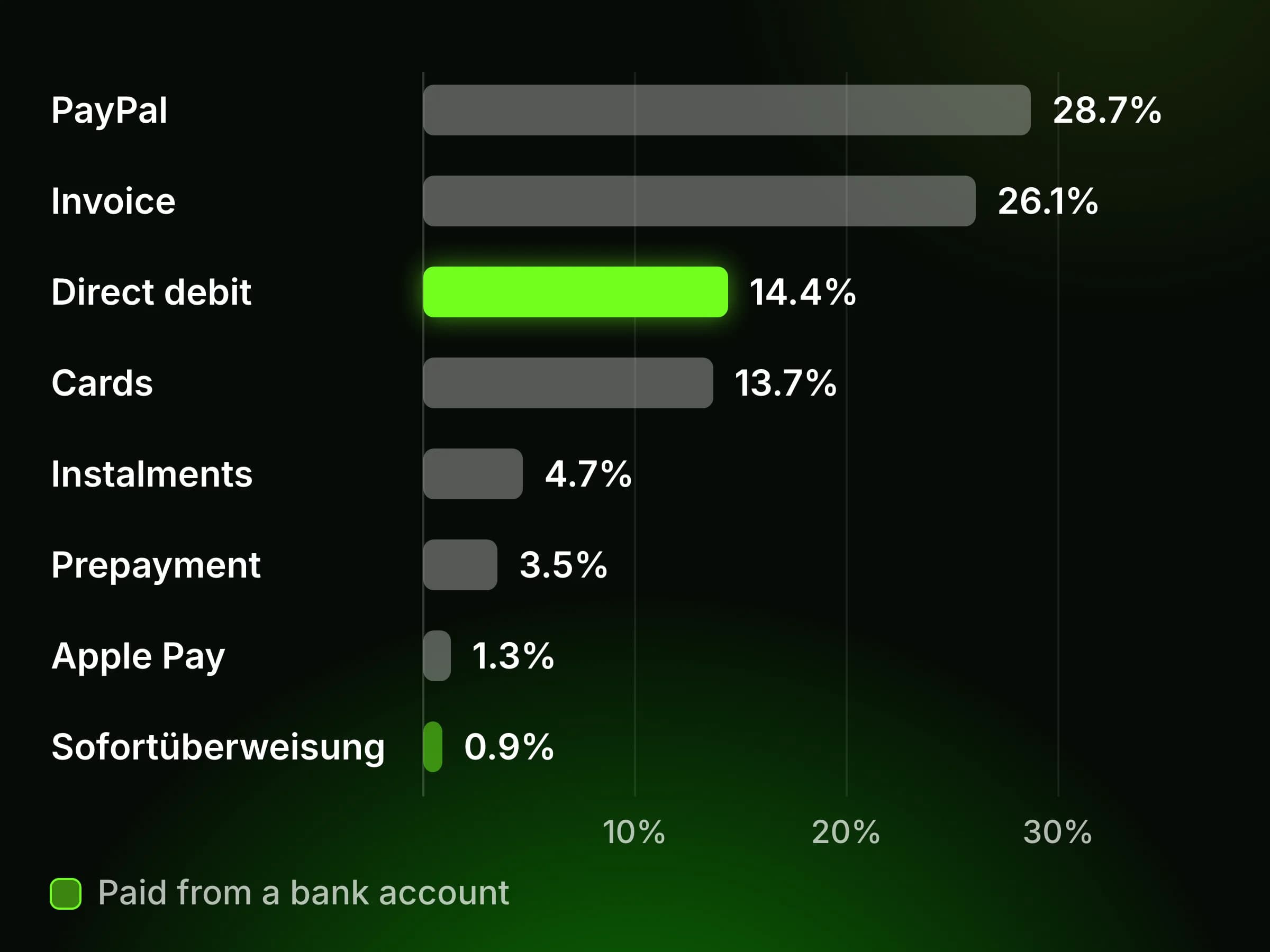
The most useful numbers come from the EHI Retail Institute, which measures how revenue splits across payment methods in a panel of 172 online merchants selling in Germany. Its 2026 study, covering 2025, shows this order:
PayPal: 28.7%
Invoice (Kauf auf Rechnung): 26.1%
Direct debit (Lastschrift): 14.4%
Credit and debit cards: 13.7%
Instalments: 4.7%
Prepayment by transfer: 3.5%
Apple Pay: 1.3%, shown separately for the first time
Sofortüberweisung: 0.9%
The order has barely moved in four years. What moves is the margin between the big three and cards:
Method | 2022 | 2023 | 2024 | 2025 |
|---|---|---|---|---|
PayPal | 29.6% | 27.7% | 28.5% | 28.7% |
Invoice | 23.8% | 26.7% | 25.8% | 26.1% |
Direct debit | 20.9% | 16.7% | 17.3% | 14.4% |
Cards | 12.1% | 11.4% | 12.3% | 13.7% |
Two caveats on these figures. They are shares of revenue in EHI’s merchant panel, not a survey of shoppers, and the mix depends on shop size: EHI reports that cards are used more at larger shops, and PayPal more at small and mid-sized ones. The Bundesbank’s own study of how Germans pay, which covers every kind of purchase, puts payments made with internet payment methods at 6% of all payments in 2025, with PayPal about 86% of that segment.
Most Germans carry a card, just not the kind that works online. About 83% of the cards issued in Germany are debit cards, and only 17% are credit cards, according to the Bundesbank. The typical debit card is a girocard, and a girocard without a Visa or Mastercard logo on it works almost only in shops. To pay online with it, the customer needs a card co-badged with Visa Debit or Debit Mastercard, which banks are now issuing more often.
So the question for a German shopper at checkout isn’t “which card?”. It’s “how do I pay without one?”. That’s the gap PayPal, invoice and direct debit filled, and the one bank-based payments are now competing for.
Giropay, the German banks’ own online payment method, closed in stages. Its owners decided on 12 June 2024 to shut it down. New registrations stopped on 23 September 2024, payments ended on 31 December 2024, and its portal and returns ran until 31 January 2025. Some sources say it stopped in mid-2024, but the merchant notices give the end of the year. By then it was small: EHI measured it at 0.4% of German online revenue in 2023.
The other well-known bank-login method changed shape too. In July 2024 Klarna ended Sofortüberweisung as a standalone payment method in Germany: customers now need a Klarna account, and it continues as Klarna’s “Pay Now”. It still showed up at 0.9% of revenue in EHI’s 2025 figures.
Wero is the wallet built by the European Payments Initiative, a group of European banks. In Germany it launched for payments between people on 2 July 2024, through the Sparkassen and the Volksbanken and Raiffeisenbanken. Online shopping followed on 17 November 2025, first at those banks, with others such as ING, Postbank and N26 adding it since. Merchants live by autumn 2026 include Decathlon, Lidl and, since August 2026, dm.
It’s live, but still small at checkout. According to Handelsblatt research in April 2026, as reported by EuroShop, none of Germany’s ten largest online retailers had integrated it, and an EHI survey found roughly three-quarters of retailers waiting to see. Wero can’t yet be used in physical shops; that is planned from 2026, though whether the timetable holds remains to be seen. User numbers quoted for Wero differ by source and mostly count payments between people, so treat any single figure with care.
Invoice is popular because the customer pays only after the goods arrive, which suits categories where customers want to try before they commit, such as fashion. The risk sits with whoever issues the invoice. A shop that invoices customers itself carries the risk of not being paid. A shop that uses an invoice provider usually hands that risk to the provider, which pays the shop and chases the customer. EHI puts the average cost of invoice to merchants at 1.42% of revenue, against 0.65% for direct debit and 1.94% for PayPal. These are averages across its panel, not prices you’ll be quoted.
Direct debit (SEPA Lastschrift) lets the merchant collect from the customer’s account under a mandate. It’s cheap, and the customer is well protected: under SEPA rules, a direct debit can be returned without giving a reason within eight weeks, and an unauthorised one within 13 months. For merchants that means money can come back weeks after the sale, which matters for anything that can’t be recovered, such as digital goods, gambling deposits or trading funds.
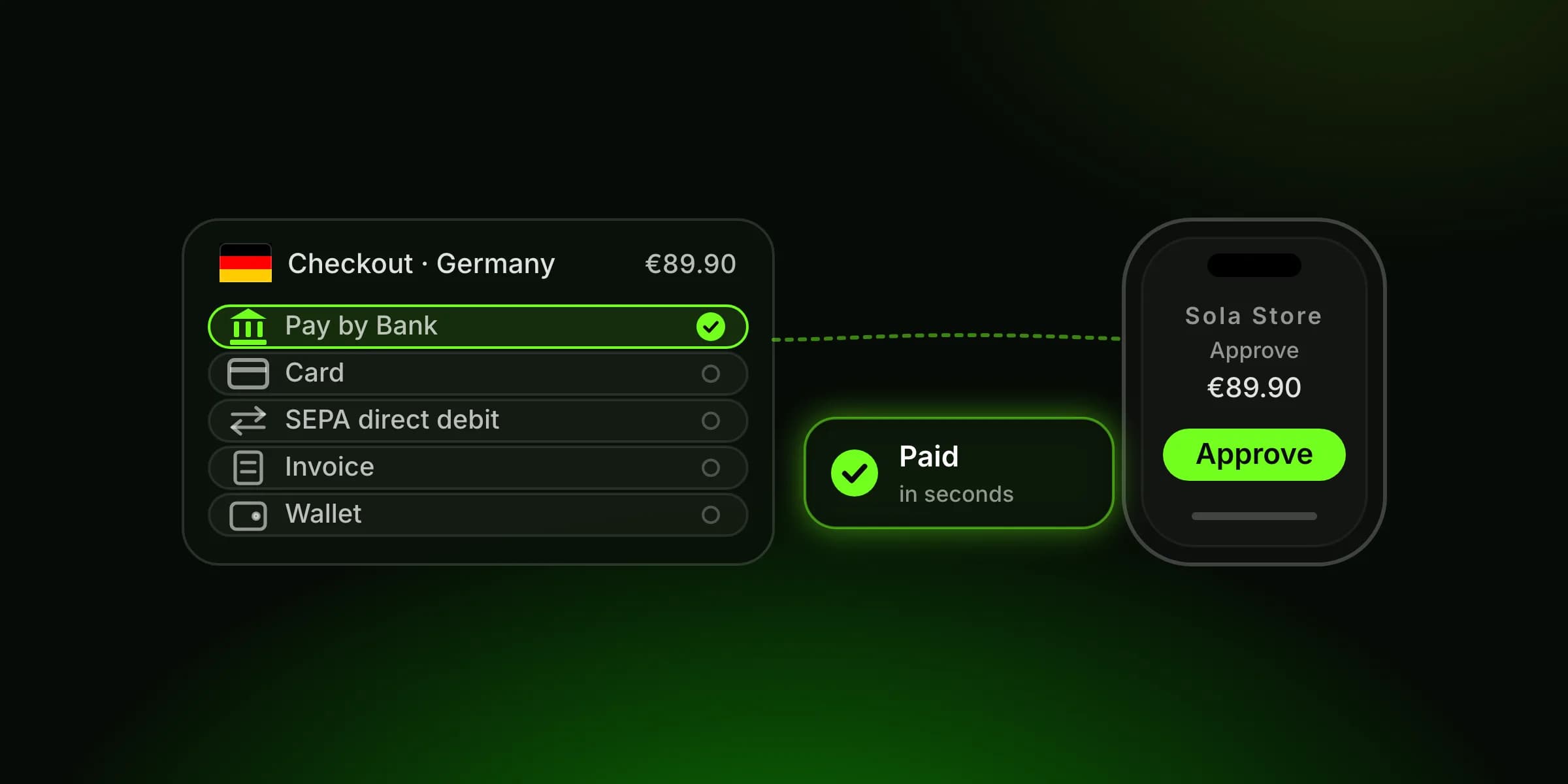
Pay by Bank is another way to pay from a bank account, built on the EU’s open banking rules. The customer picks their bank at checkout, approves the payment in their banking app, and returns to the shop. The money comes from their account, approved by them in their bank, rather than collected later under a mandate.
For German customers it fits a habit many already have. Bank transfers are a familiar way to pay, and Pay by Bank keeps the bank but removes the typing of IBANs and references. Customers of the Sparkassen and Volksbanken can use it, as can those of the large private banks and direct banks. Confirmation is typically a matter of seconds, and settlement is in euros.
It isn’t giropay’s successor, and it isn’t Wero. It’s a payment initiated through the customer’s bank, which a shop can offer whatever happens to wallet adoption. It works best where its strengths count: larger baskets, customers who want to pay from their account without signing a mandate, and businesses that can’t afford a payment coming back eight weeks later.
There’s no single right answer, but there is a sensible starting point by type of business. The EHI figures show why the mix matters. In its panel, PayPal and invoice together cover 54.8% of online revenue; add direct debit and it’s 69.2%; add cards and it’s 82.9%. A shop with only cards reaches about 14%.
Every shop: PayPal, cards (including Apple Pay and Google Pay for mobile and international customers), and one bank-based option.
Fashion and other try-before-you-buy categories: add invoice through a provider that carries the risk. It’s the second most used method in the EHI panel, and running it yourself means running a collections operation.
Subscriptions and recurring payments: direct debit, for its low cost and familiarity, accepting the eight-week refund window.
High-value baskets, digital goods and regulated businesses: Pay by Bank, for payments approved in the customer’s own bank, with no card chargeback scheme and no eight-week direct debit return. The customer’s bank still handles claims for payments they didn’t authorise.
Watch Wero. If your customers bank mostly with Sparkassen and Volksbanken, it may matter sooner for you than for others.
Sola provides Pay by Bank and card processing, with Apple Pay and Google Pay on the card connection. Invoice, direct debit and PayPal aren’t part of what we provide; you’d use other providers for those.
PayPal, with 28.7% of online revenue in 2025 in the EHI Retail Institute’s panel of German shops. Invoice, paying after delivery, is a close second at 26.1%, followed by direct debit at 14.4% and cards at 13.7%.
No. Giropay stopped processing payments on 31 December 2024, after its owners, the German banks, decided in June 2024 to close it. New registrations had already stopped in September 2024, and the customer portal closed on 31 January 2025.
Not much. Only about 17% of cards issued in Germany are credit cards, and the common girocard debit card works online only when it is co-badged with Visa or Mastercard. Cards took 13.7% of online revenue in 2025 in the EHI panel.
Wero is a payment wallet from the European Payments Initiative, a group of European banks. In Germany it has worked for payments between people since July 2024 and for online shopping since November 2025, through banks including the Sparkassen, Volksbanken, ING and Postbank. It isn’t yet available in physical shops.
Yes. They can pay by bank transfer in advance, by direct debit under a mandate, by Wero at shops that accept it, or by Pay by Bank, where they choose their bank at checkout and approve the payment in their banking app.
Sola offers Pay by Bank and cards for German customers, with euro settlement and authentication inside the customer’s own banking app. Customers of Sparkassen, Volksbanken, Deutsche Bank, Commerzbank, ING, Postbank, DKB, N26 and many more pick their bank at checkout and approve in its app. Confirmation is typically a matter of seconds, and if a bank is slow, the payment shows as pending and updates automatically. See Pay by Bank in Germany, how Pay by Bank works, and our card processing.
EHI Online-Payment 2026, as reported, IT-Finanzmagazin, 8 May 2026
Zahlungsverhalten in Deutschland 2025, Deutsche Bundesbank, 17 June 2026
Monthly Report, December 2025 (card payments in Germany), Deutsche Bundesbank
SEPA direct debit, Deutsche Bundesbank
Banks end giropay: what it meant for online shops, heise online, June 2024 (EHI share)
Paydirekt closes giropay: what merchants and customers need to know, Händlerbund, 8 October 2024
Wero launches for online shopping in Germany, European Payments Initiative, 17 November 2025
dm introduces Wero, European Payments Initiative, 25 August 2026
Wero in 2026: reticence in online retail, EuroShop, 25 August 2026
Klarna stops Sofortüberweisung as a separate payment method, Händlerbund, 19 July 2024
Selling to German customers?
Send your German volumes and current setup. We come back with a written cost comparison and a go-live plan.
Get a cost comparisonPayments strategy
NEWSLETTER
New articles on Open Banking, card costs, routing and regulation — straight to your inbox. Unsubscribe in one click.