
BLOG · Industries
Matchday payments: how sportsbooks get players funded before kick-off
What breaks in sportsbook payments in the minutes before kick-off, how cards and bank payments behave under load and at weekends, and a 30-minute checklist.
Most of what goes wrong in sportsbook payment processing goes wrong in the same few minutes: the stretch before kick-off, when players who have been thinking about the match all day finally open the app and try to deposit. A payment that would sail through on a Tuesday morning fails at 19:55 on a Saturday, and the bet it was meant to fund never gets placed.
Short answer: deposits fail before kick-off for reasons that pile up under load. Issuers answer slowly, 3D Secure challenges get abandoned on phones, risk rules tuned for normal traffic flag eager players, and some banks run maintenance at weekends. Bank payments on SEPA Instant settle in seconds at any hour, but a standard bank transfer started on a Saturday usually waits until Monday. The fix is mostly preparation, not technology.
What a matchday deposit curve looks like
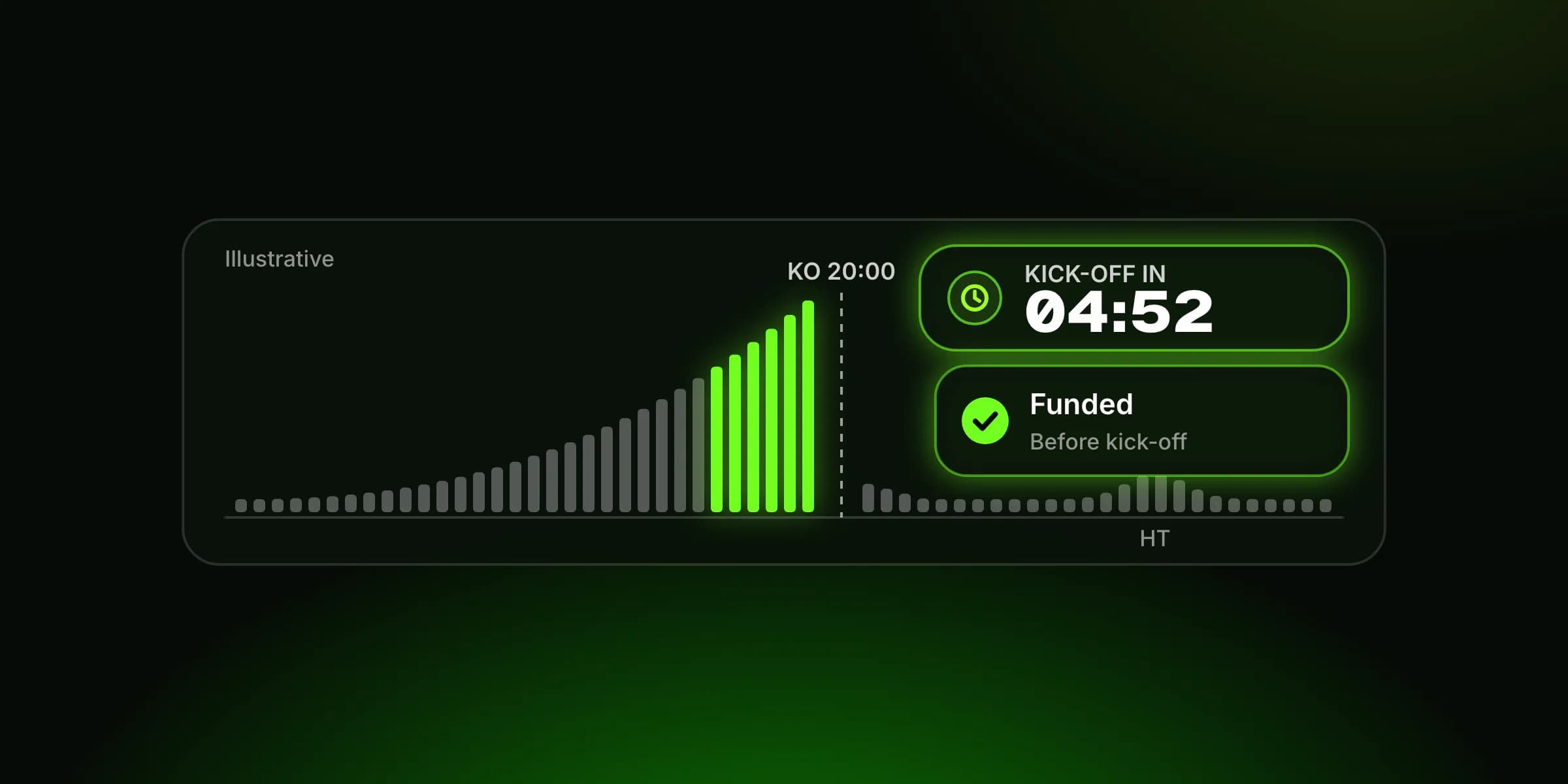
Traffic on a matchday isn’t flat. It builds through the afternoon, rises steeply in the half hour before kick-off, dips once the match starts, and comes back in bursts: at half-time, after a goal, after a red card, whenever odds move and players want in. Then, when markets settle, the flow reverses and withdrawals arrive together.
Public numbers on football peaks are scarce, and we won’t invent them. The best figures we found come from one UK payment provider’s data on UK sportsbooks during the Cheltenham Festival in March 2026. That is horse racing, not football, but the pattern is the point. Average throughput rose 40% on the previous week, to 6.4 transactions a second, with daily peaks up to 34 a second.
A short, steep peak is harder than a long, high one. Systems sized for the average fail at the top of the curve, and the top of the curve is exactly when players are least patient.
Where deposits fail under load
Five things go wrong, often at once.
The issuer answers slowly. Card authorisation goes to the player’s bank and back. Issuers are generally expected to answer within a few seconds; when they don’t, the network may decide for them, or the request times out. Neither is a deposit.
3D Secure meets a phone. When the issuer asks for a challenge, the player leaves your app for their banking app or types a one-time code, then has to come back. On a phone, mid-conversation, three minutes before kick-off, a share of players don’t finish. A deposit abandoned at the challenge looks like a decline in your data.
Your own risk rules fire. Velocity rules that treat three deposits in five minutes as suspicious are sensible on a Tuesday. On a matchday they catch your most engaged players. The fix isn’t switching rules off, which would also switch off safer-gambling signals, but separating the patterns that mean fraud from the ones that mean a fixture.
A bank is down. Banks schedule maintenance, sometimes at night and at weekends. One payment provider’s status page showed a 40-minute window on a Saturday morning in June 2025: SEPA Instant payments couldn’t be sent, and outgoing payments fell back to standard transfers that stayed pending until Monday. Under the EU’s open banking technical standards, banks have to publish quarterly statistics on the availability of the interfaces payment providers use, and keep contingency plans. That doesn’t make every bank available at kick-off, but it does mean you can look up which ones struggle.
Rate limits and queues. Somewhere in the chain (your provider, a bank connection, your own API) there is a limit on requests per second. Hit it and payments wait, then time out.
Card payment processing on matchday
On the one public dataset we found, cards and Apple Pay were the most used methods. Cards behave reasonably under load when two things are in place. Frictionless 3D Secure, where the issuer allows it, avoids the challenge entirely. It’s the issuer’s decision, but sending complete data with every request improves the odds. Network tokens keep stored card details valid after a reissue, so a returning player doesn’t hit an expired card at the worst moment.
What cards can’t avoid is the issuer: a slow or offline issuer, or one that declines gambling as policy, is out of your hands. That is the case for having a second method on the cashier screen, visible, at the moment the card fails.
Bank payments on matchday
A bank payment takes a different path. The player approves the deposit in their own banking app, and the money moves between bank accounts with no card in between. With SEPA Instant, the transfer must complete within 10 seconds, 24 hours a day, every day of the year, including Saturday at 19:55 and Christmas Day. Since October 2025, euro-area banks have had to be able to send instant payments, under the Instant Payments Regulation. Payment institutions and e-money institutions have until April 2027.
There is a catch, and it matters most at weekends. If the player’s bank sends the payment as a standard SEPA credit transfer instead of an instant one, it settles through T2, the euro settlement system, which is closed on Saturdays and Sundays. A standard bank payment started at 19:30 on a Saturday usually arrives on Monday morning, roughly 36 hours later and long after the final whistle. Transfers within the same bank can be faster.
That is why “pending” is the most dangerous status before kick-off. The player has approved the payment, their bank has accepted it, and the money isn’t there. Your cashier needs to know which state a payment is in and say so plainly, so the player doesn’t pay twice and doesn’t feel cheated.
The 30 minutes before kick-off: a checklist
Most of this takes ten minutes on a quiet Tuesday and saves a bad Saturday. Run it for the fixtures that matter:
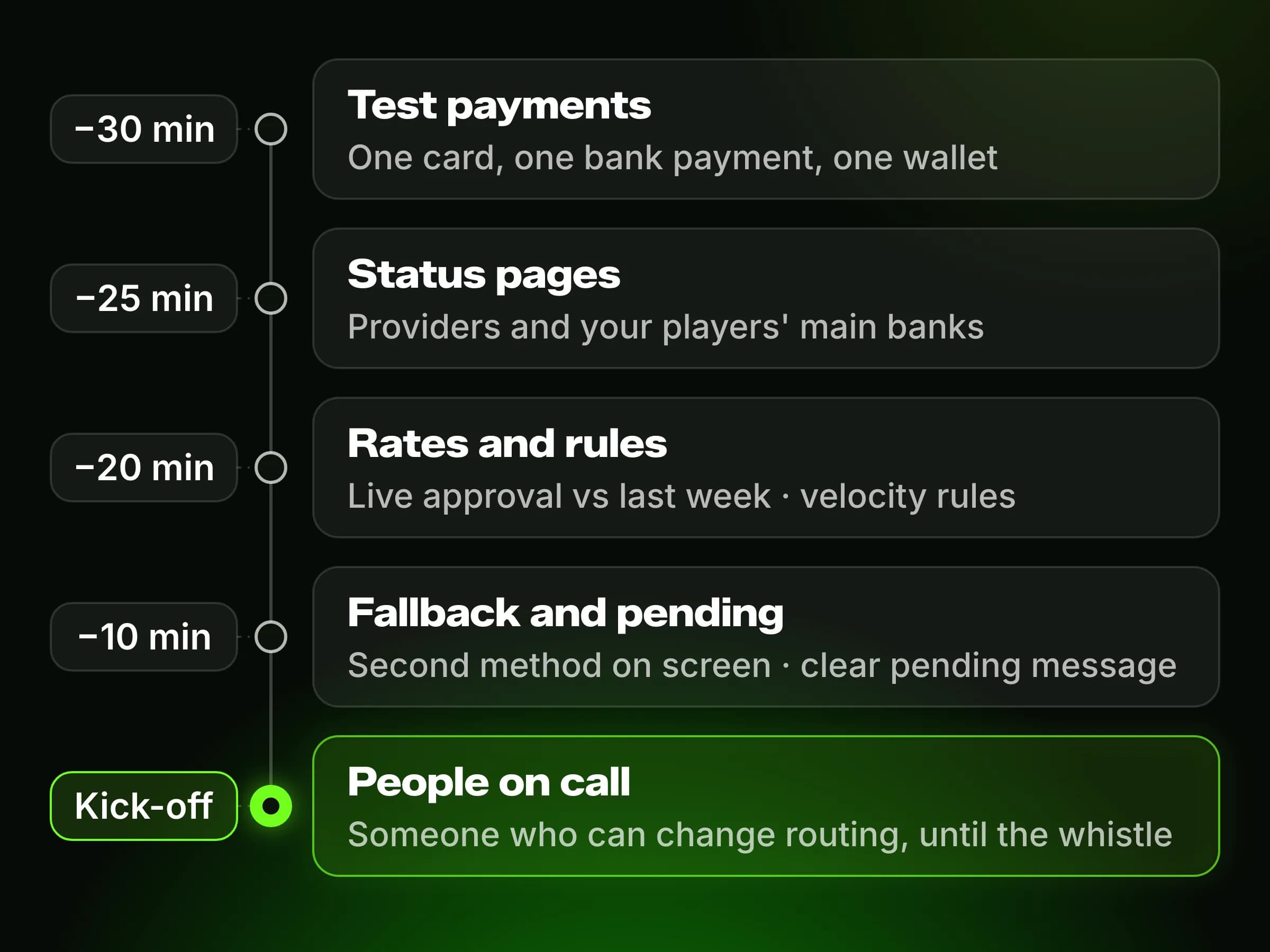
Send test payments on every method 30 minutes out: a card, a bank payment through your main markets’ biggest banks, a wallet. A failed test at 19:30 is cheap; a failed queue at 19:55 isn’t.
Check scheduled maintenance. Your providers’ status pages, and the published availability of the banks most of your players use.
Compare live authorisation rates with the same slot last week, by issuer country and by bank, in one-minute buckets. A drop at one bank is visible here before it shows in revenue.
Review velocity rules for the fixture. Make sure repeat deposits from known, verified players aren’t treated as fraud, and that your safer-gambling limits still apply.
Keep a second method on screen when the first fails. A declined card should lead straight to another way to pay, not to an error page.
Make returning players fast. A saved card or a remembered bank turns a three-screen deposit into one approval.
Word your pending message. “Received, confirming with your bank” beats a spinner, and stops a second payment.
Name the person on call who can change routing priorities and talk to your providers, until the final whistle.
After the final whistle: withdrawals
When markets settle, the queue reverses. Winners want their money, and how fast it arrives shapes whether they come back for the next match. The same discipline applies: payouts that run as batches instead of queueing one by one, status a player can see, and money returned to where it came from. With Sola, payouts to cards run today, and payouts to bank accounts are coming soon.
Frequently asked questions
Why do betting deposits fail before kick-off?
Mostly because several things happen at once: issuers answer slowly under load, players abandon 3D Secure challenges on their phones, fraud rules flag repeated deposits, and some banks run maintenance at weekends. Ordinary reasons add to it: insufficient funds, card limits, or a bank that declines gambling payments as policy.
How long does a SEPA Instant payment take?
At most 10 seconds from the moment the player’s bank receives the payment order. SEPA Instant runs 24 hours a day, every day of the year, including weekends and bank holidays, and the receiving bank must confirm within the same 10 seconds.
Do SEPA transfers work at weekends?
Instant ones do. Standard SEPA credit transfers settle through T2, which is closed on Saturdays, Sundays and six holidays a year, so a standard transfer started on a Saturday is usually processed on Monday. Whether a payment goes instant depends on how it’s requested and on what the player’s bank or account supports: banks have had to offer instant sending since October 2025, payment and e-money institutions by April 2027.
Why does 3D Secure fail on mobile?
A challenge sends the player away from your app, to their banking app or to a code sent by text, and back. Each switch is a chance to give up or time out, and on a phone, in a hurry, more players do. Frictionless approval avoids the challenge, but whether to grant it is the issuer’s decision.
Is there a limit on SEPA Instant payments?
There is no longer a limit set by the scheme itself: the European Payments Council dropped its €100,000 default maximum in the rulebook that took effect in October 2025. Banks can still set their own limits, and players can set personal limits on instant payments, so a large deposit can still be refused.
Where Sola fits
Sola adds Pay by Bank deposits to your cashier, in euros, approved in the player’s banking app across 3,000+ connected banks, with the player’s bank remembered so the next top-up is one approval. Routing moves volume to the connections confirming fastest in each market, and status reaches you by webhook or polling, pending included. Our platform is monitored around the clock, with an on-call engineer 24/7. More on sports betting payments, and on why card deposits get declined. For the rules behind instant payments, see SEPA Instant and Verification of Payee.
Sources
SEPA Instant Credit Transfer, European Central Bank
Instant Payments Regulation: implementation deadlines, European Central Bank
Status update on the SCT Inst scheme (maximum amount), European Payments Council for the ERPB, 21 November 2024
T2 operating days and closing days, European Central Bank
Regulation (EU) 2024/886 on instant credit transfers in euro, EUR-Lex, 13 March 2024
Delegated Regulation (EU) 2018/389, Articles 32 and 33, EUR-Lex
Q&A 2023_6687 on the period covered by availability statistics, European Banking Authority, 29 September 2023
EMV 3-D Secure, EMVCo
Cheltenham Festival 2026 payment volumes, The Power50, March 2026 (one provider’s data)
Talk through your matchday peak
Share your busiest fixture: volumes, declines and methods. We'll show where deposits were lost and where routing and bank payments could help.
Book a call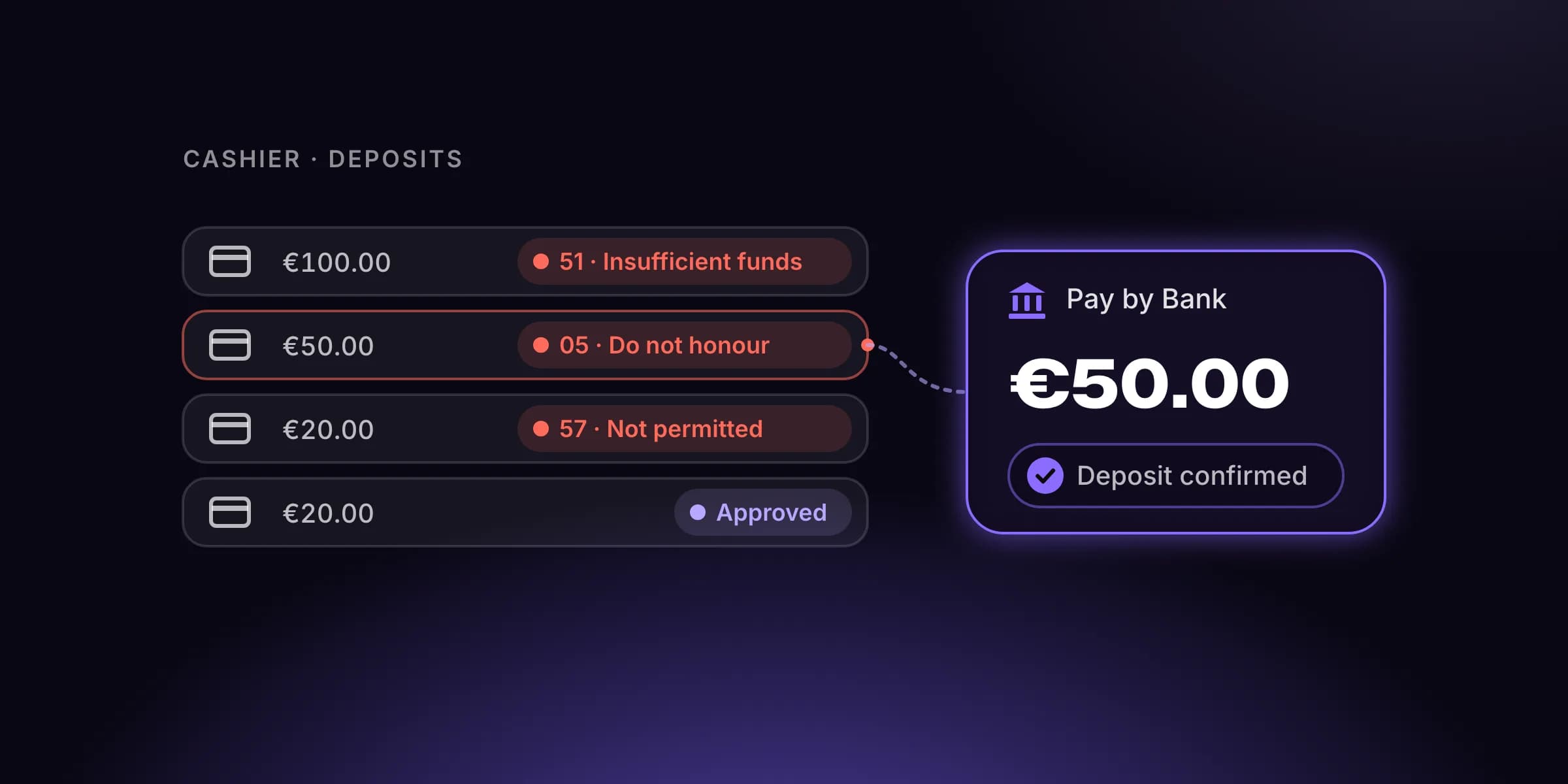
NEWSLETTER
One email a month. No fluff.
New articles on Open Banking, card costs, routing and regulation — straight to your inbox. Unsubscribe in one click.