
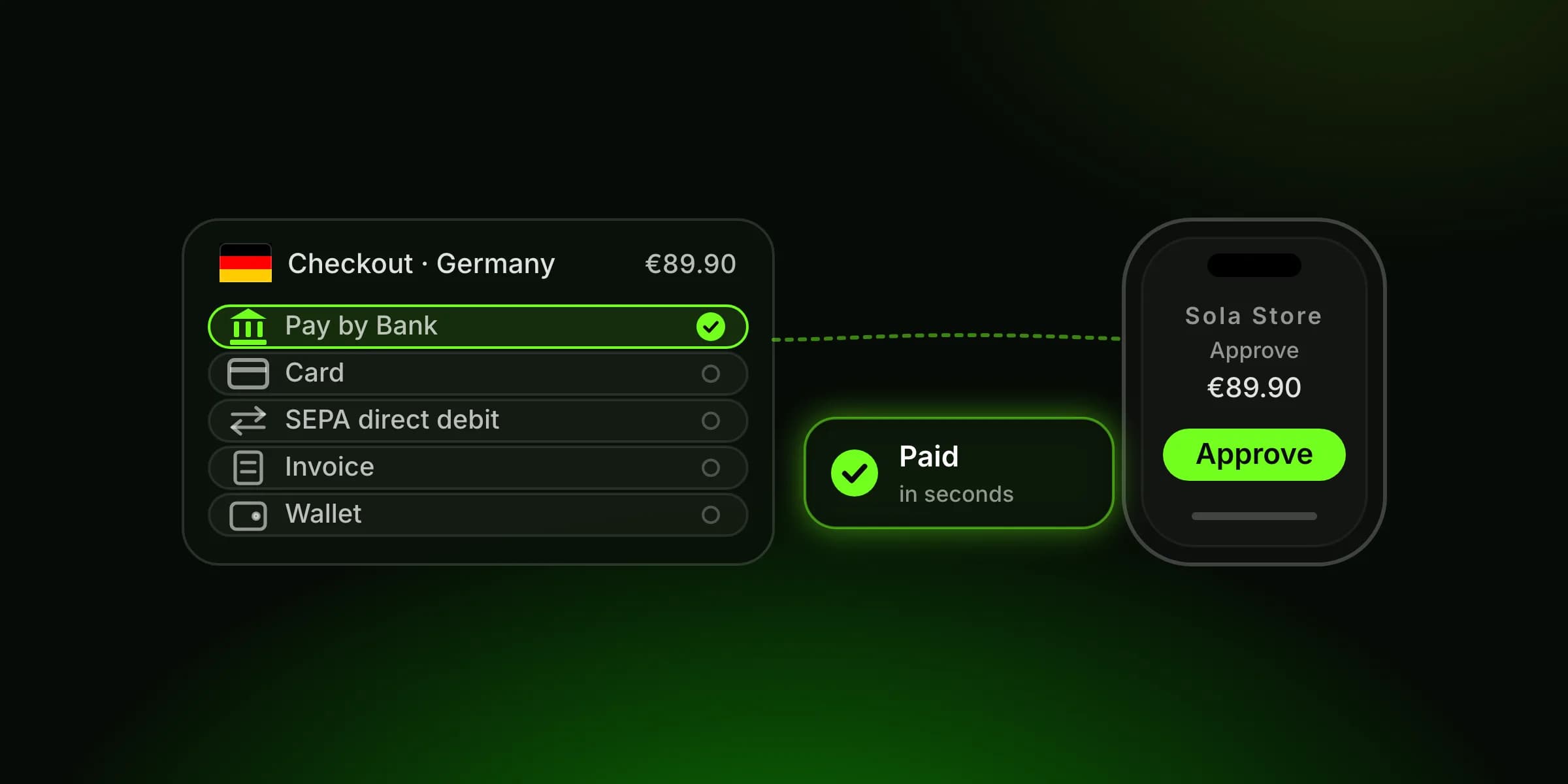
BLOG · Payments strategy
Pay by Bank vs card payments: what each sale really costs
A €120 sale priced line by line on both rails, three basket sizes side by side, and the costs that never make it onto a rate card.
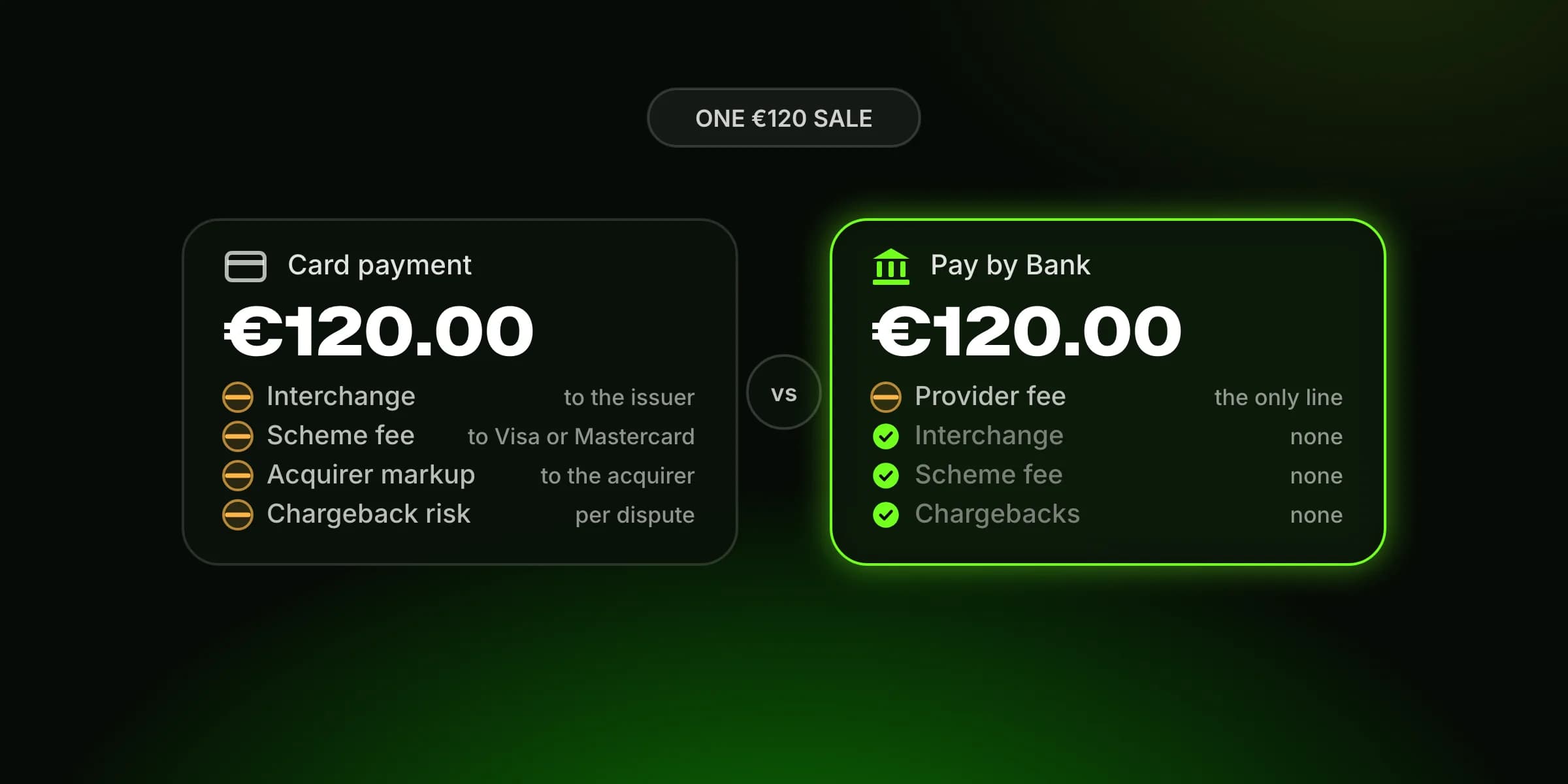
Pay by Bank vs card payments sounds like a simple price comparison. It stops being simple the moment you price a real basket, because a card payment isn’t one fee: it is up to four, and how big they are depends on the card in your customer’s hand.
Short answer: on an EEA consumer debit card bought at cost-plus pricing, a card payment can cost as little as 0.4% to 0.7%, and a bank payment won’t always beat that on small baskets. On blended card pricing, on business cards, on cards issued outside the EEA and on large baskets, a bank payment usually costs far less, and there is no chargeback scheme behind it.
Below, one €120 sale priced line by line on both rails, three basket sizes side by side, and the costs that never make it onto a rate card.
Pay by Bank vs cards at a glance
Card payment | Pay by Bank | |
|---|---|---|
How the customer approves | Card details, then 3D Secure if the bank asks | In their own banking app |
Who is paid along the way | Card issuer, Visa or Mastercard, the acquirer, your provider | Your provider |
Price shape | A percentage plus a fixed fee, varying by card type | A flat fee or a percentage plus a fixed fee |
Chargebacks | Yes, through the card scheme | No chargeback scheme |
Refunds | Sent back to the card | A new payment you send to the customer |
When the money is yours | Usually one or two business days, by contract | Seconds, where the customer’s bank supports instant payments |
Who can use it | Anyone with a card | Customers whose bank is connected and who bank online |
What a card payment costs, line by line
Take the cheapest card there is for a merchant: a consumer debit card issued in the EEA, used online at an EEA shop, priced on interchange++ (each cost passed through separately). Here is a €120 sale:
Interchange To the card issuer, capped at 0.2% | €0.24 |
Scheme fee To Visa or Mastercard, depending on scheme and tier | €0.06 to €0.47 |
Acquirer markup Assumed at 0.10% + €0.05 | €0.17 |
Cost of the sale | €0.47 to €0.88 |
That is about 0.4% to 0.7% of the sale. The interchange line is capped by law: Regulation (EU) 2015/751 caps it at 0.2% for consumer debit and 0.3% for consumer credit. Scheme fees come from the published scheme tables as one acquirer lists them, and the range is wide because Visa and Mastercard price differently and by tier. The markup is an assumption, because no neutral source publishes what acquirers charge across the EU.
An analysis by Germany’s Council of Economic Experts, summarised by the SAFE institute, puts the same layers at about 0.2% to 0.3% interchange, around 0.1% for the card network and an average 0.06% for the acquirer. Same order of magnitude.
When the card is premium, business or from outside the EEA
The cap covers consumer cards issued and used in the EEA, and nothing else. On the same €120 sale online, interchange alone becomes:
A business card issued in the EEA: around 1.65% to 2.00% in the schemes’ published tables, so €1.98 to €2.40 before any other fee.
A consumer card issued outside the EEA: 1.15% for debit and 1.50% for credit online, under commitments Visa and Mastercard gave the European Commission and extended to November 2029. That is €1.38 to €1.80, and scheme fees on these cards are higher too.
A UK card at an EEA shop: since October 2021, the same 1.15% and 1.50% online.
Then there is the way most smaller merchants actually buy card acceptance: a blended price list. Two providers’ published lists price standard EEA cards at 1.5% + €0.25 and 1.80% + €0.25, so €2.05 to €2.41 on €120. Premium and international cards on those lists run from 2.8% to 3.25% + €0.25. If you’re not sure which model you’re on, our guide to interchange++ and blended pricing shows how to tell from a statement.
What a Pay by Bank payment costs
A bank payment has no card in it. The customer approves a transfer from their own account in their banking app, and the money moves account to account. No issuer takes interchange, no scheme takes a fee, and there is no acquirer. You pay one party: the provider that connects you to the banks and runs the payment.
It isn’t free, and anyone who says so has something to sell. Published price lists show two shapes:
A flat fee per payment. That’s how bank-based methods such as iDEAL in the Netherlands are often priced: €0.29 and €0.32 a payment in two providers’ published lists.
A percentage plus a fixed fee. One provider lists its Pay by Bank at 0.45% + €0.25.
These are other providers’ list prices, used here to show structure. Your own quote will differ, and the shape of it matters as much as the level.
Three baskets, side by side: €25, €120 and €900
Here are four prices applied to three basket sizes. The card on cost-plus pricing uses a simplified midpoint of the €120 build-up, 0.50% + €0.07, and the flat bank payment uses €0.30, between the two published flat prices.
Basket | Card, EEA debit, cost-plus | Card, blended 1.5% + €0.25 | Bank payment, flat €0.30 | Pay by Bank, 0.45% + €0.25 |
|---|---|---|---|---|
€25 | €0.20 (0.78%) | €0.63 (2.50%) | €0.30 (1.20%) | €0.36 (1.45%) |
€120 | €0.67 (0.56%) | €2.05 (1.71%) | €0.30 (0.25%) | €0.79 (0.66%) |
€900 | €4.57 (0.51%) | €13.75 (1.53%) | €0.30 (0.03%) | €4.30 (0.48%) |
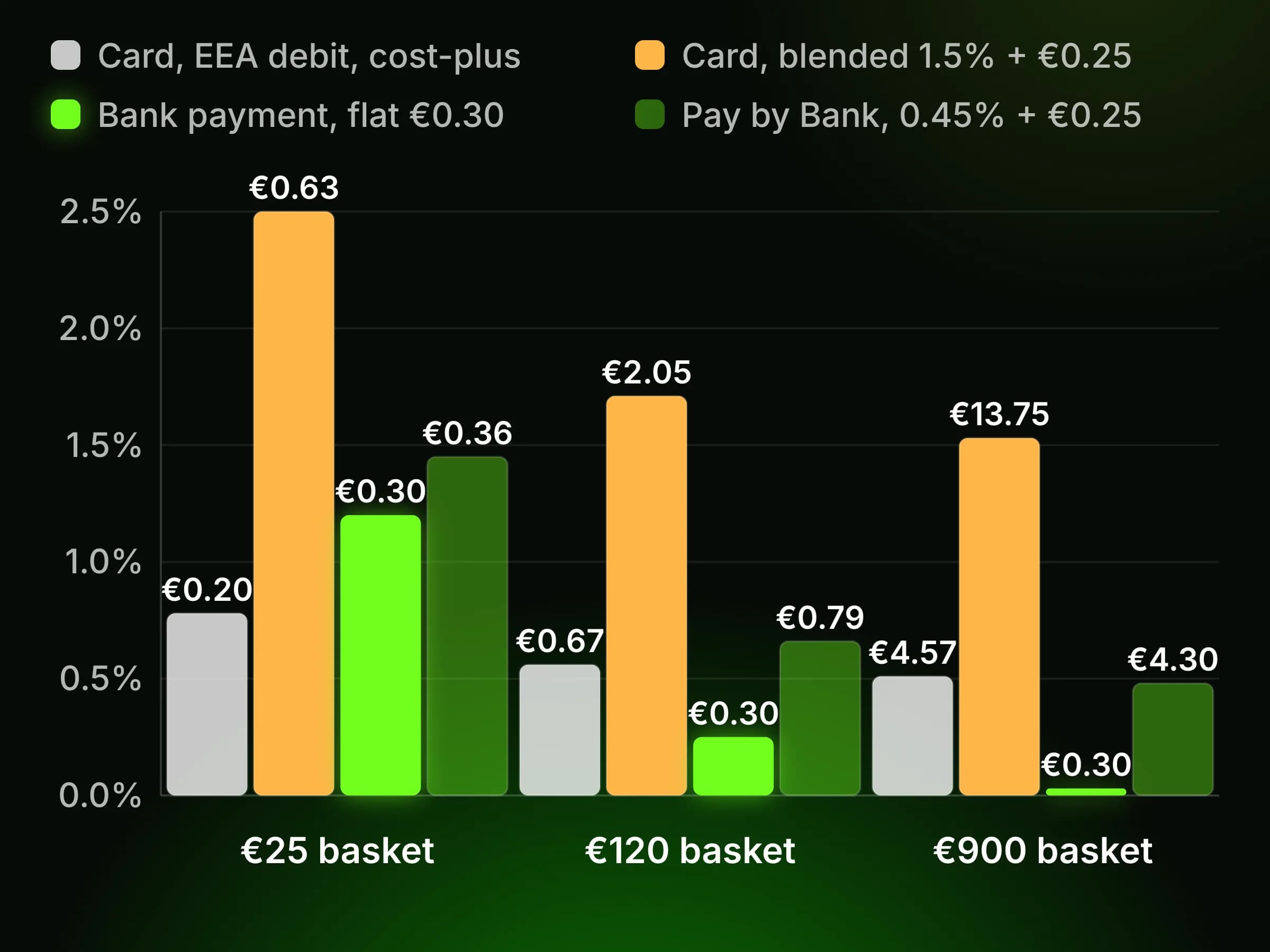
Three things stand out.
Against blended card pricing, the bank payment wins at every size. The fixed fees cancel out, and the percentage is lower or absent.
Against cost-plus pricing on EEA debit cards, it depends on the shape of the bank fee. A flat €0.30 fee beats the card above about €46. A fee of 0.45% + €0.25 only beats it above about €360. Below those points, the cheap card wins.
On business cards and cards from outside the EEA, the bank payment wins easily, because interchange alone on a €120 card sale is €1.38 to €2.40.
So the crossover isn’t one number. It moves with your card mix, with how you buy card acceptance, and with the shape of the bank payment fee you’re quoted.
The costs that never show on the rate card
The per-sale price is the visible part. Four other costs often decide the comparison.
Chargebacks. A card payment can be disputed weeks or months after the sale. Each dispute costs a fee, €20 in one provider’s published list, plus the goods and the revenue if you lose. At a 0.5% dispute rate on 10,000 sales a month, that is 50 disputes and €1,000 in fees alone. A bank payment has no chargeback scheme: the customer authorised it in their own bank, and under the EU’s payment services rules (PSD2) a payment order is irrevocable once their bank has received it. That doesn’t end disputes. A customer who wants their money back talks to you, and a refund is a payment you send.
Declines. A declined card is a lost sale, not a cost line, which is why it rarely gets counted. Offering the customer their bank when a card fails turns some of those into completed payments, and that revenue belongs in the comparison too.
Settlement float. Card money usually reaches you one or two business days after the sale, depending on your contract. A bank payment on instant rails is confirmed in seconds. On €1m a month, two days of float at a 4% cost of money is about €219 a month. Real, but small for most businesses.
Currency conversion. If you take cards in other currencies, conversion can add more than the processing itself. One published list adds 2% when currency is converted: €2.40 on a €120 sale.
The protection the customer keeps matters too. Under PSD2, a payment the customer did not authorise must be refunded by their bank by the end of the next business day, and they have up to 13 months to report it. A payment they did authorise has no chargeback. EU reforms under discussion would add some fraud refund rights, but they are not law yet.
Where cards still win
A fair comparison has a second column. Cards are the better choice in more places than vendor blogs admit:
Small baskets on cost-plus card pricing. On a €25 sale with an EEA debit card, the card was the cheapest option in the table above.
Customers who want credit. Paying later, spreading the cost or collecting card rewards are reasons to choose a card, and a bank payment offers none of them.
Wallets on mobile. Apple Pay and Google Pay take one glance or one tap. A bank payment takes a trip into the banking app and back.
Customers outside the bank payment’s reach. Not everyone banks online, not every bank is connected, and with Sola, Pay by Bank runs in euros.
Refunds and disputes the customer expects. Some customers buy with a card precisely because they know the dispute process is there.
That is why most merchants who add bank payments keep cards. The question is not which rail wins. It is which share of your volume belongs on which.
How to run this on your own numbers
You can get to a real answer from data you already have:
Find your effective card rate by card type. Total fees divided by volume, split into EEA consumer, business and non-EEA cards. Your provider has to give you the breakdown on request.
Map your basket sizes. The share of your volume under €50, between €50 and €300, and above. The crossover sits somewhere in that spread.
Estimate how much would move. Start with the payments where it pays most: large baskets, business customers, declined cards. Don’t assume everyone switches.
Price that share at a bank payment quote, including disputes avoided and declined sales recovered, and compare it with what the same payments cost today.
Frequently asked questions
Is Pay by Bank cheaper than card payments?
Usually, but not always. A bank payment has no interchange or scheme fees, so it costs less than a card on blended pricing, on business cards, on cards issued outside the EEA and on large baskets. On small baskets paid with EEA consumer debit cards at cost-plus pricing, the card can be cheaper.
How much do card payments cost a merchant in Europe?
It depends on the card and how you buy acceptance. An EEA consumer debit card on cost-plus pricing costs roughly 0.4% to 0.7% of the sale. Blended price lists for standard EEA cards run around 1.5% to 1.8% plus a fixed fee, and premium, business and international cards cost more.
Does Pay by Bank have chargebacks?
No. A bank payment is a push payment the customer authorises in their own banking app, so there is no chargeback scheme. Customers keep their rights for payments they did not authorise. A customer who wants their money back for any other reason asks you, and a refund is a new payment you send.
How do refunds work with Pay by Bank?
A refund is a separate payment from your account back to the customer’s, rather than a reversal of the original. With instant payments it can reach the customer in seconds. Whether refunds run from your payment dashboard or from your own bank depends on your provider.
How fast does a Pay by Bank payment arrive?
On instant rails, in seconds: SEPA Instant must complete within 10 seconds, at any hour, on any day. Not every bank sends every payment instantly, and a standard SEPA transfer arrives by the end of the next business day. Card money usually reaches a merchant one or two business days after the sale.
Where Sola fits
Sola adds Pay by Bank beside the card setup you already have: in euros, across 3,000+ banks, approved in the customer’s banking app. It can be the cheaper route, a fallback when cards decline, or both, and both rails land in one report. Refunds from the dashboard are coming soon. If you also run cards through us, they sit on the same integration. Tell us what you pay today and we’ll come back with a written cost comparison. More on Pay by Bank for merchants, and on what your customer sees during the payment.
Sources
Regulation (EU) 2015/751 on interchange fees for card-based payment transactions, EUR-Lex, 29 April 2015
Directive (EU) 2015/2366 on payment services (PSD2), EUR-Lex, 25 November 2015
Regulation (EU) 2024/886 on instant credit transfers in euro, EUR-Lex, 13 March 2024
Study on the application of the Interchange Fee Regulation, Copenhagen Economics and EY for the European Commission, March 2020
The price of paying: Europe’s payments and the digital euro, SAFE, Leibniz Institute for Financial Research, 20 May 2026
Visa and Mastercard extend inter-regional fee caps in the EEA, FStech, July 2024
Run this on your own statements
Send three months of card statements. We come back with a written comparison of what you pay today and what would move to Pay by Bank, usually within two working days.
Get a cost comparison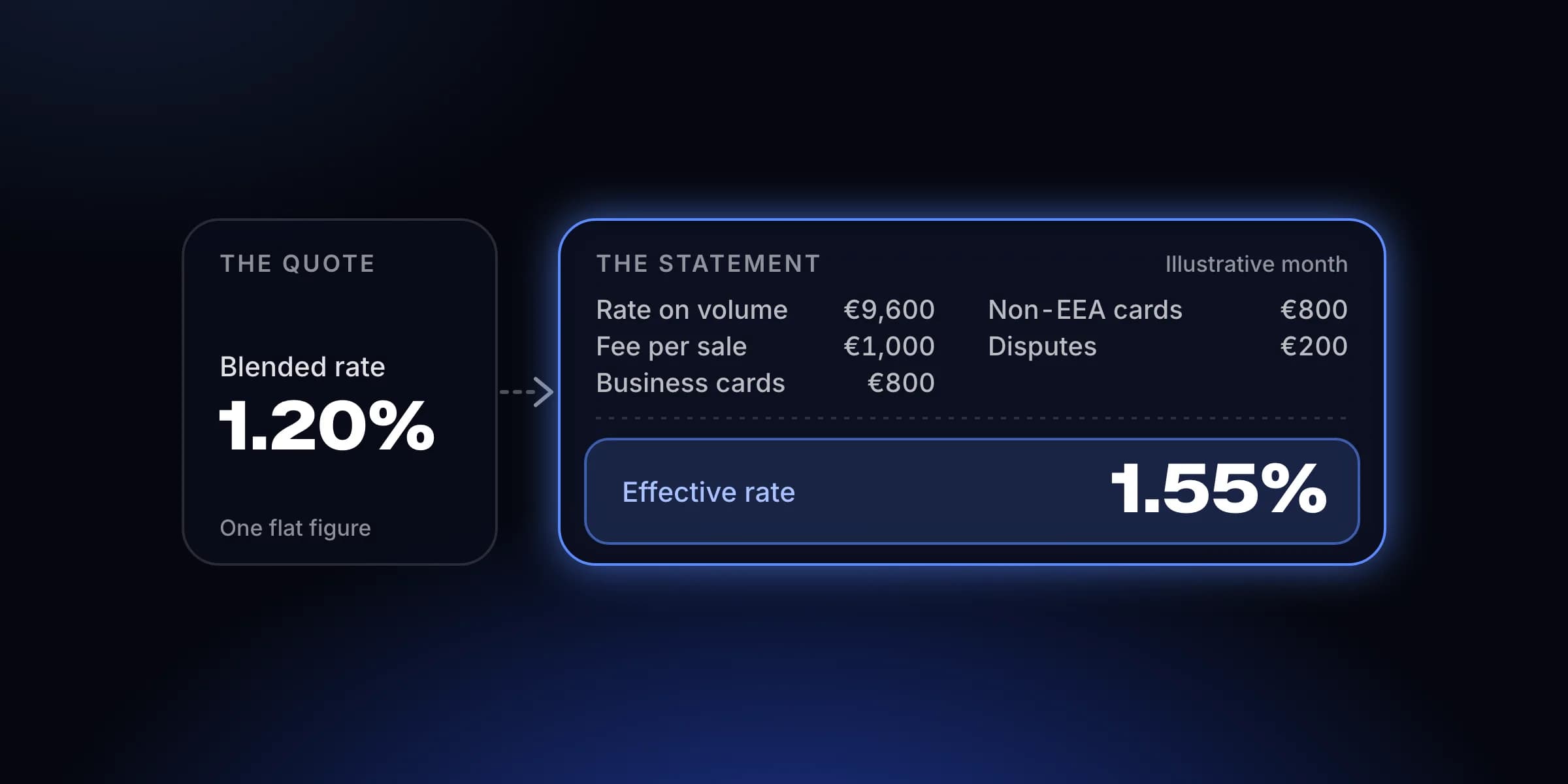
NEWSLETTER
One email a month. No fluff.
New articles on Open Banking, card costs, routing and regulation — straight to your inbox. Unsubscribe in one click.