
BLOG · Industries
Payment methods for forex brokers: deposits, withdrawals and the third-party rule
Cards, bank transfers and Pay by Bank compared on what a regulated broker actually needs: speed, proof of who paid, dispute exposure and a clean route back.
Most comparisons of forex broker payment methods stop at speed and price. For a regulated broker those matter, but two other questions decide more: can you prove the money came from your client, and can you send it back the same way? A deposit that’s fast but disputable, or cheap but untraceable, costs more later than it saves today.
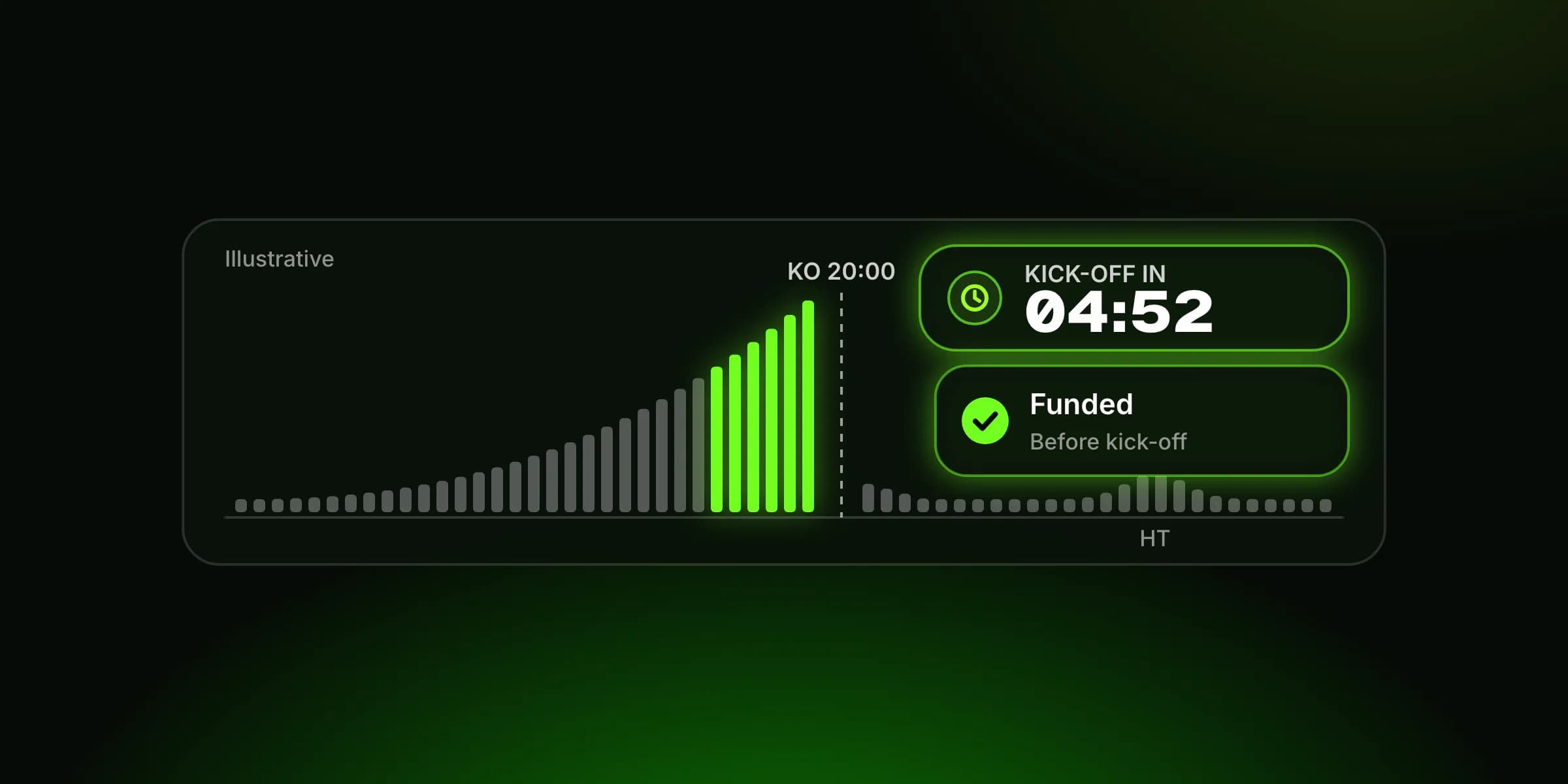
Short answer: cards fund fastest but leave you open to disputes for months, including after a client loses money. Bank transfers are cheap but slow, and you only learn who paid once the money has arrived. Pay by Bank sits between them: the client approves in their own bank, there is no chargeback scheme behind it, and the payment comes from an account they control. Many brokers keep all three and route each client to the right one.
What a regulated broker needs from its payment methods
Five things, in roughly this order:
Speed to fund. A margin call doesn’t wait for a card authorisation to retry or a transfer to clear on Monday.
Proof of who paid. Your anti-money-laundering checks depend on knowing the money came from the client, not a friend, an employer or someone you’ve never heard of.
A route back. Withdrawals have to go back to where the money came from, and you have to be able to show that they did.
Low dispute exposure. Card disputes after trading losses are a known exposure for brokers.
Clean reconciliation. Every deposit matched to a client account without someone reading payment references by hand.
No single method scores well on all five, which is why the comparison is worth doing method by method.
Cards: fast to fund, expensive to dispute
Cards are the default for retail clients: familiar, instant to credit, available everywhere. Their problem shows up later.
A card payment can be disputed for months. Under Visa’s rules, a cardholder who says they didn’t authorise an online payment can dispute it for up to 120 days from processing. For a deposit made on 3 March, that runs to about 1 July. A client who funds €5,000 in March, trades it to a loss in April and disputes in June leaves you defending a card dispute about a trading loss, with your account history as evidence. Banks say they can’t reverse genuine trading losses, but a dispute still costs you time and fees, and you can lose it. Other dispute types, such as services not received, can run longer: up to 540 days under Visa’s rules.
Cards also shape withdrawals. Visa’s rules say a refund should go back to the same card where possible, and don’t allow a credit to a card without a previous sale to that cardholder. In practice, many brokers return up to the deposited amount to the card and pay anything above it, the profit, by bank transfer. That is broker practice built around the scheme rules, not a scheme rule in itself, so check your acquirer’s position before you write it into your terms.
Bank transfers: cheap, slow and anonymous until they land
A plain bank transfer costs little and carries no chargeback risk. Its weaknesses are on the operations side.
The client sends money with a reference, and you match it to their account when it arrives, by hand or by rules that break whenever someone mistypes the reference. A standard SEPA transfer arrives by the end of the next business day after the bank receives it, so a deposit sent on Friday afternoon may not fund the account until Monday, and one sent after the bank’s cut-off may take until Tuesday. And you only find out who actually paid once the money is already in your account. If it came from someone other than your client, you now have to send it back.
Pay by Bank: the client’s own account, approved in their bank
With Pay by Bank, your client chooses their bank at your cashier and approves the deposit in their own banking app, using their bank’s strong customer authentication. It’s a push payment from their account: there is no card, so there is no chargeback scheme behind it, and where their bank supports instant payments the funds are confirmed in seconds.
The question brokers ask most is what it tells you about the payer. Under PSD2 and its technical standards, the client’s bank must give the payment provider the same information about the payment that the client would see paying directly. The European Banking Authority’s guidance adds that the payer’s name should be made available where the bank shows it to its own customer, and where the provider can justify needing it. That’s not a guarantee for every bank. Separately, a SEPA credit transfer carries the payer’s name and account number in the payment data itself, which is what makes the account holder checkable against your client record. How much of it reaches you depends on how your provider settles payments to you.
Two limits to keep in mind. A bank payment needs the client to bank online with a connected bank. And a payment the client authorised has no card chargeback behind it, which is good for you, but means disputes run through your own complaints process.
Return to source: how withdrawals have to flow
Every regulated broker pays withdrawals back to where the deposit came from. The rule is so universal that it’s worth knowing where it actually comes from, because it isn’t one line of law.
In Cyprus, CySEC’s circulars set out the core. During the short window in which a new client’s identity is still being verified, its 2016 circular C143 allowed deposits only from a bank account in the client’s own name, capped cumulative deposits at €2,000, and required the broker to return the funds to the same account if verification wasn’t completed within 15 days, profits included and losses deducted. CySEC has since revisited those rules in a 2025 circular, so check the current text before quoting the numbers. Its 2018 inspection findings name returning funds “by way of the same bank account from which they originated, always in the same name” as best practice. And its anti-money-laundering directive lists settlement by a third person as a sign of a suspicious transaction.
Brokers turn those pieces into one blanket policy: no third-party payments in, and everything back to source on the way out. Here is how that plays out on a client who funded by card and made a profit:
Deposited by card 3 March | €5,000 |
Balance at withdrawal After trading | €7,150 |
Back to the card Up to the amount the card funded | €5,000 |
To the client’s own bank account The profit, once that account is verified | €2,150 |
Total withdrawn | €7,150 |
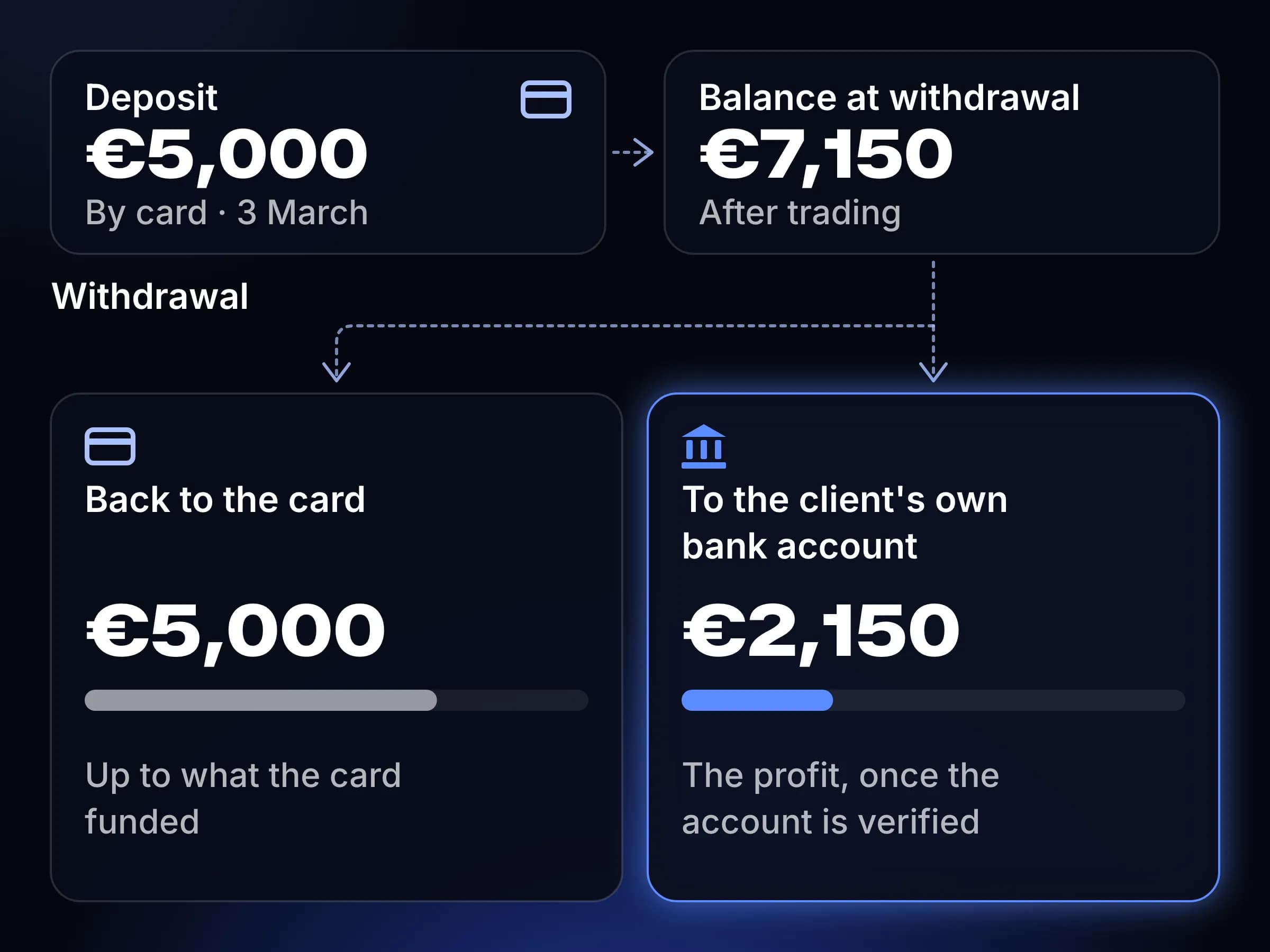
The pinch point is that last line. A client who only ever funded by card has no verified bank account on file, and the profit can’t move until they have one. A client who funded by bank payment from the start already has an account on file in their own name.
The third-party rule, without manual checks
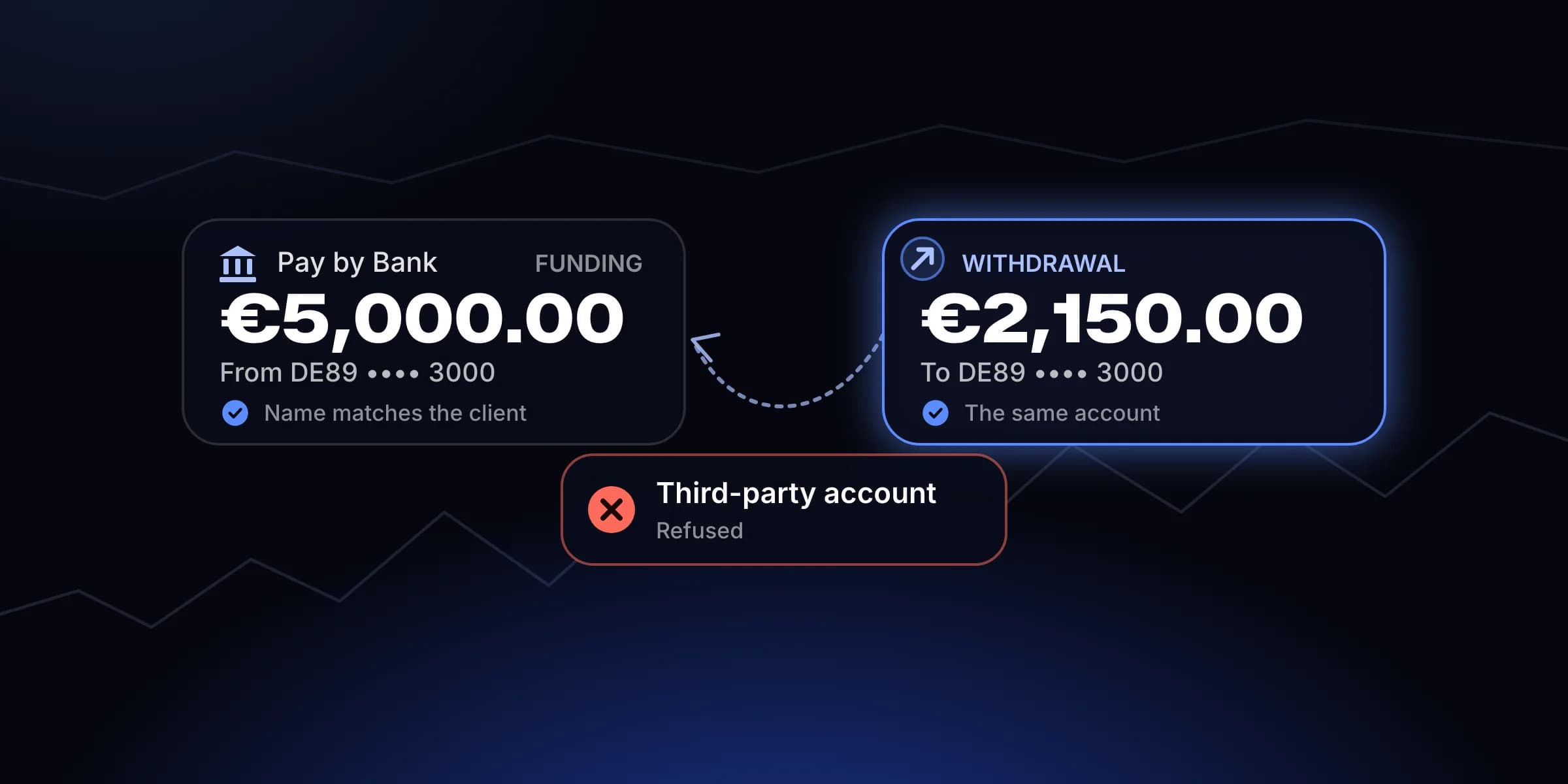
Most third-party problems are caught too late: after the money has arrived and been credited. The cleaner approach is to check the payer before the deposit counts:
Know which account the money came from, from the payment data rather than a reference the client typed.
Compare the account holder with the client. Decide in advance how you treat joint accounts, which many brokers accept “in the same name or joint”, and business clients paying from company accounts.
Refuse what doesn’t match, and return it to source, without crediting the trading account first.
Keep the trail with the payment: who paid, from which account, what you checked, and where the money went back to.
The fewer deposits arrive by methods that hide the payer, the less of this needs a person.
Comparing the methods
Card | Bank transfer | Pay by Bank | |
|---|---|---|---|
Speed to fund | Instant authorisation | Next business day for standard SEPA | Seconds where the bank supports instant payments |
Who paid | The cardholder, per the card | Visible only once the money lands | The client’s bank account, approved by them |
Dispute exposure | Chargebacks, up to 120 days for unauthorised online payments | None through a scheme | No chargeback scheme |
Route back | To the same card, up to the deposited amount | To the originating account | To the originating account |
Reconciliation | Automatic | References, often manual | Matched to the payment |
Frequently asked questions
Which payment methods do forex brokers accept?
Most regulated brokers accept debit and credit cards, bank transfers and some e-wallets, and some add Pay by Bank. Which ones a broker offers depends on its regulator, its acquirer and its clients’ countries. Most keep several methods so that each client can fund the fastest way their bank allows.
Why do forex withdrawals go back to the deposit source?
To stop client accounts being used to move money between people. Returning funds to the account or card they came from is how brokers typically apply their anti-money-laundering duties. In Cyprus, CySEC’s circulars point brokers to own-name accounts and same-account returns, and brokers write it into their terms as a blanket rule.
Can a forex broker accept third-party payments?
Regulated brokers generally don’t. CySEC’s anti-money-laundering directive treats settlement by someone other than the client as a sign of a suspicious transaction, and brokers’ own policies refuse third-party deposits outright and return them to source. Some accept joint accounts held in the client’s name.
What is a forex payment gateway?
A forex payment gateway connects a broker’s cashier to the ways clients pay: card acquiring, bank transfers, bank payments and e-wallets. It routes each deposit, confirms it, and passes the result to the broker’s back office, and it handles withdrawals back to the source. Regulated brokers use gateways that work with licensed payment institutions.
Where Sola fits
Sola works with brokers regulated in the markets they serve, and asks for the permissions during onboarding. Clients fund by Pay by Bank from their own account, approved in their own bank, across 3,000+ connected banks in euros; funding from third-party accounts is refused on the way in and on the way out. Cards stay where they still work. Payouts to cards run today. Payouts to bank accounts are coming soon, so until then a bank-funded client’s withdrawal to their bank account isn’t yet a Sola payout. Payment services are provided by our licensed partner institutions, with the trail attached to every payment. More on payments for regulated forex brokers, on how the client’s approval works, and on payouts.
This article describes published rules and common practice. The EU’s new anti-money-laundering regulation, (EU) 2024/1624, applies from 10 July 2027 and will change parts of the picture. This isn’t legal advice: check your own regulator’s current requirements.
Sources
Circular C143 on articles 61 and 62 of the AML Law, Cyprus Securities and Exchange Commission, 24 June 2016
Circular C260 on common weaknesses found in AML inspections, CySEC, 23 February 2018
Directive for the prevention and suppression of money laundering (unofficial English consolidation), CySEC
Visa Core Rules and Visa Product and Service Rules, Visa, 18 April 2026
Q&A 2018_4081 on the payer’s name for payment initiation, European Banking Authority, amended 20 December 2019
Delegated Regulation (EU) 2018/389, technical standards on strong customer authentication, EUR-Lex
Regulation (EU) 2024/1624, the EU anti-money-laundering regulation, EUR-Lex, applying from July 2027
Map your funding flows
Tell us how clients fund and withdraw today. We'll show where Pay by Bank fits, what changes in reconciliation, and what it would cost.
Talk to our team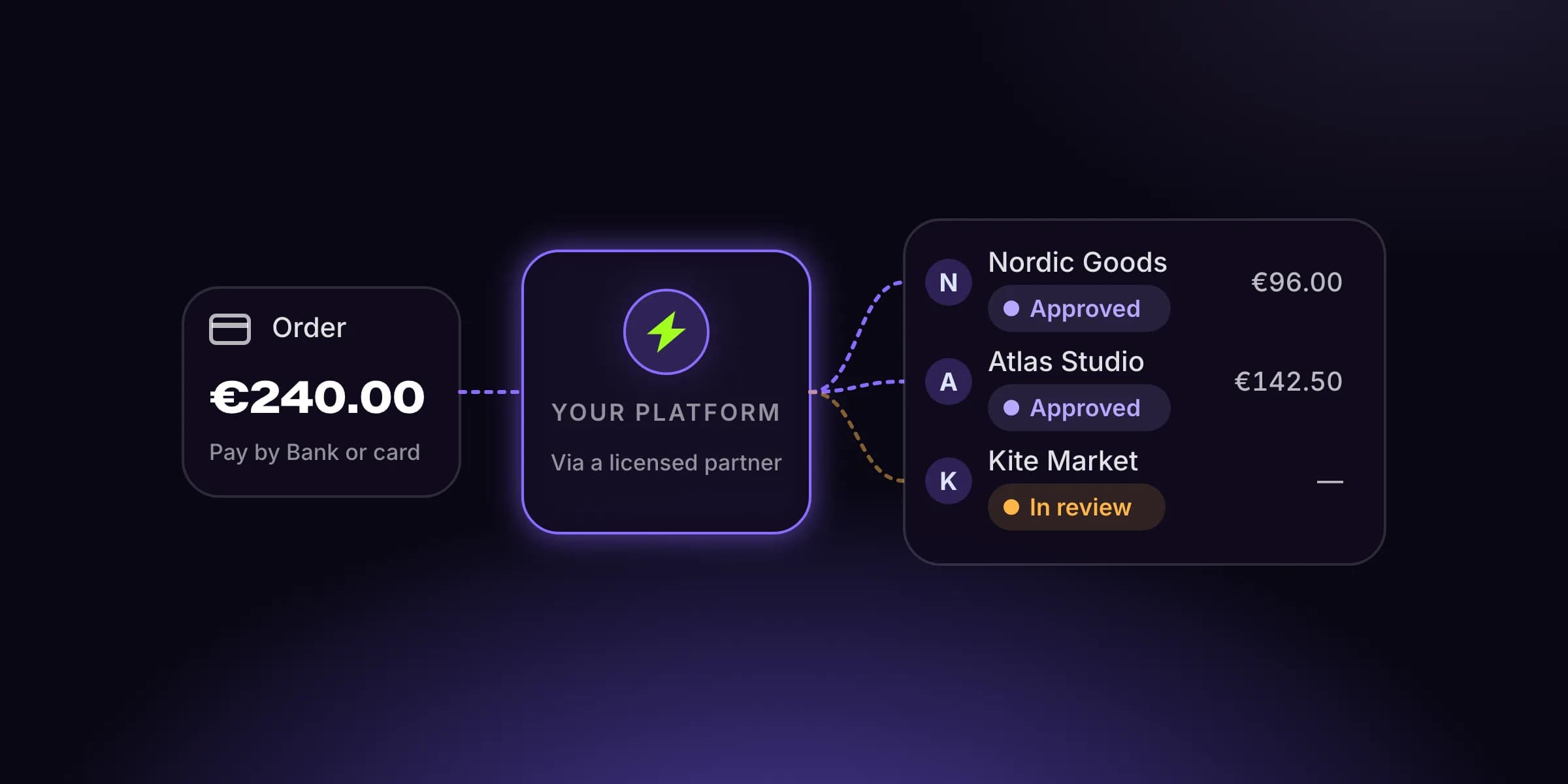
NEWSLETTER
One email a month. No fluff.
New articles on Open Banking, card costs, routing and regulation — straight to your inbox. Unsubscribe in one click.