
BLOG · Industries
Card declines in iGaming: why deposits fail and how to win them back
The five kinds of card decline an operator sees, which codes to retry and which never to, the schemes' retry rules, and when a second route or a bank payment helps.
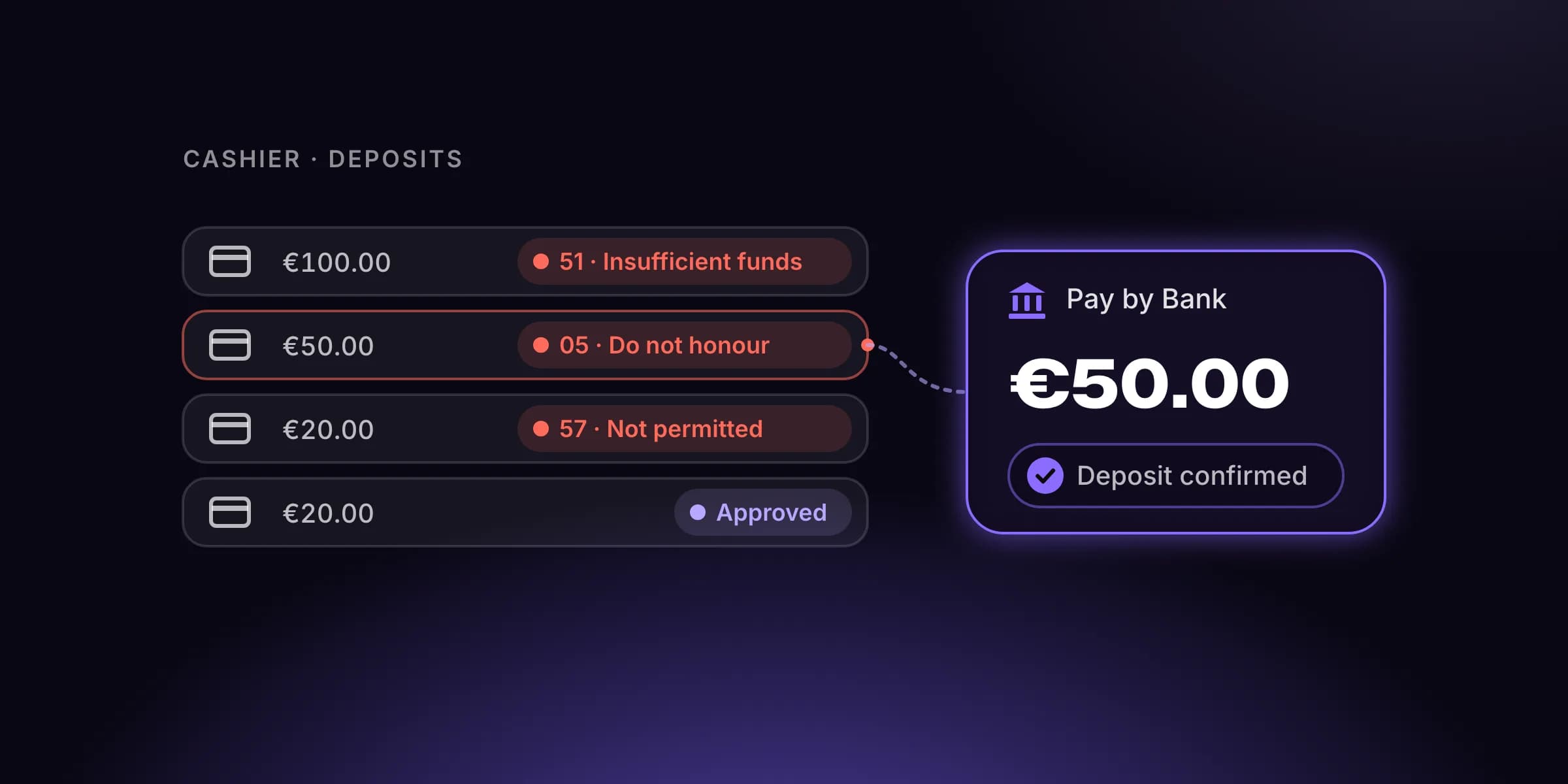
A declined deposit is a player standing at your cashier with money they wanted to spend, and nowhere to put it. iGaming payment declines are rarely one problem. Behind the same red message sit five different causes, and treating them all the same way, usually by retrying, makes some of them worse.
Short answer: acquirers and processors consistently report that gambling deposits are declined more often than most card payments, though no scheme publishes a figure. The usual reasons: issuers treat the gambling merchant code (MCC 7995) as high risk, players can block gambling at their bank, and a 3D Secure check can fail or be abandoned, especially on a phone. Some declines are worth retrying later. Others must never be retried. A second payment route helps with technical failures, and a bank payment helps when the card issuer’s policy is the problem.
Why iGaming payments are declined more often
Every card payment carries a merchant category code that tells the issuer what kind of business is charging the card. Online casinos and sportsbooks use 7995: betting, including casino gaming chips, off-track betting and wagers. Issuers see it on every deposit.
The schemes treat it carefully. Visa’s own Integrity Risk Program, for example, puts card-absent gambling under MCC 7995 in its highest-risk tier, alongside a short list of other categories. Acquirers need Visa’s separate approval to take on merchants in that tier, and every such merchant must be registered with Visa before it can process. Those controls sit with the acquirer, not the issuer. What issuers then do with a 7995 payment is their own policy: some approve, some review, some decline, and policies differ by card type.
That is the backdrop. On top of it come the causes you can actually tell apart.
The five kinds of decline you’ll see
1. Issuer policy on gambling. The issuer doesn’t want gambling on this card, or this card type, full stop. Retrying changes nothing. You’ll often see a generic “do not honour” (05) or “transaction not permitted” (57).
2. Gambling blocks the player set. Many banks now let customers block gambling payments themselves. The UK Gambling Commission lists eleven UK banks and providers with gambling controls, most of them card blocks. In Ireland, Bank of Ireland, AIB, EBS, Revolut and PTSB offer them. A player who switched one on made a decision about their own gambling. Credit cards are a related case: Great Britain has banned them for gambling since 14 April 2020, and Ireland’s ban came in with the commencement order of 5 February 2026.
3. Funds, limits and restrictions. Insufficient funds (51) and an amount over the card’s limit (61) are about the player’s balance and settings, not your business. A restricted card (62) can be the card’s settings or an issuer or country policy.
4. Authentication. Strong customer authentication with 3D Secure applies to most deposits in practice. The exemptions (payments up to €30, for instance, within a cumulative €100 or five payments since the last check) are the issuer’s choice, and many deposits are above them anyway. A failed or abandoned challenge on a phone, mid-match or mid-session, ends as a decline.
5. Risk rules and technical failures. Your own fraud filters, your acquirer’s, or the issuer’s systems: “issuer unavailable” (91) and “system error” (96) are the honest ones. These are the declines a second route can actually recover.
Soft and hard declines: what to retry and what never to
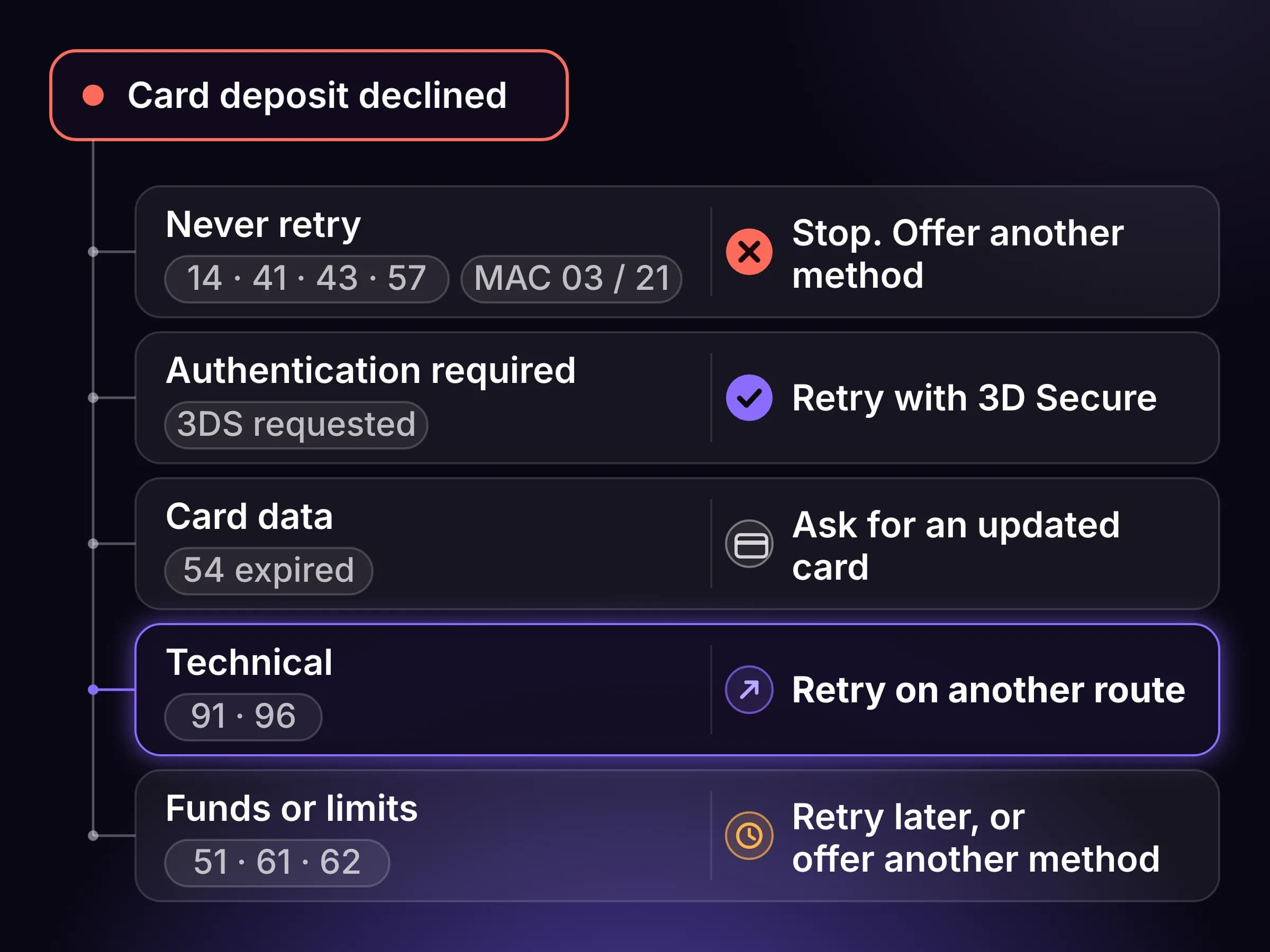
“Soft” and “hard” are industry shorthand rather than scheme terms, but they map well onto what the schemes do define. Visa sorts its response codes into four categories, the first of which means the issuer will never approve and must not be retried. Mastercard adds a merchant advice code (MAC) to many declines, telling you whether and when to try again.
Here is how the common codes break down. The meanings come from Mastercard’s published response code table; the retry guidance follows Visa’s categories and Mastercard’s advice codes:
Code | What the issuer is saying | What to do |
|---|---|---|
05 | Do not honour, no reason given | Don’t hammer it. One later retry at most, then offer another method |
14 | Invalid card number | Never retry this number. Ask for the card details again |
41, 43 | Lost or stolen card | Never retry. Review the player account |
51 | Insufficient funds | Retry later, not straight away. On Mastercard, the advice code says when |
54 | Expired card | Fix the data: ask the player to update the card |
57 | Transaction not permitted | Never retry. Offer another method |
59 | Suspected fraud | Don’t retry blindly. Ask the player to contact their bank or authenticate |
61, 62 | Over a limit, or a restricted card | Retry later at most, or offer another method |
91, 96 | Issuer or system unavailable | Retry, ideally on another route |
Authentication required | The issuer wants 3D Secure | Retry with a 3D Secure challenge |
One warning on that last row: schemes and regions signal “authentication required” differently, and code 65 means different things depending on who sends it. Map it from your acquirer’s documentation, not from a list online.
The schemes’ retry rules
Retrying isn’t free, and past a point it’s against the rules.
Visa caps reattempts on the same card within 30 days and forbids any reattempt after a Category 1 decline. Its 2020 rule change, which covered Europe from April 2021, set the cap at 15 reattempts in 30 days. Several acquirers now report it as 20 since May 2025, while others still document 15. Confirm the current number with your acquirer. Excess attempts are charged, through your acquirer, at amounts Visa doesn’t publish.
Mastercard uses its advice codes. MAC 03 means do not try again, and MAC 21 means stop recurring payments on this card. Codes 24 to 30 mean try again after a set wait, from one hour (24) to ten days (30). Mastercard reportedly also charges for excessive authorisation attempts.
The practical rule: retry only what the scheme says is retryable, space the attempts the way the advice codes say, and count retries per card across all your routes, not per route.
Routing and cascading: when a second acquirer helps
Cascading means sending a declined payment to a second acquirer, and sometimes a third. It works for one kind of decline: failures caused by the route itself, such as an acquirer outage, a technical error, or a risk rule on one side that the other doesn’t share.
It doesn’t work for the others, and it can hurt. A card blocked by issuer policy is blocked whichever acquirer asks. A player’s own gambling block is still their decision on the second attempt. And every cascaded attempt on the same card counts towards the scheme retry limits above.
The better version of routing happens before the first attempt: choosing, for each deposit, the route most likely to succeed for that player’s country, bank and card, based on recent results. Fewer first-attempt declines beat clever recovery.
Here is what the arithmetic looks like on a month of 100,000 card deposit attempts at an average of €50, with every input an assumption you should replace with your own:
Declined at the first attempt At an assumed 70% authorisation rate | 30,000 |
Never-retry declines Assumed 25% of declines | 7,500 |
Soft declines Not on the never-retry list | 22,500 |
Recovered by a second route or method Assumed 15% of those, a rate to replace with your own | 3,375 |
Deposits recovered in the month 3,375 at €50 each | €168,750 |
Only some soft declines are failures of the route, which is why 15% is deliberately modest. Even so, recovery moves the authorisation rate by a few points: from 70% to about 73.4% here. That’s real money, and it’s also why the decline mix matters more than the retry logic.
Offering a bank payment when the card fails
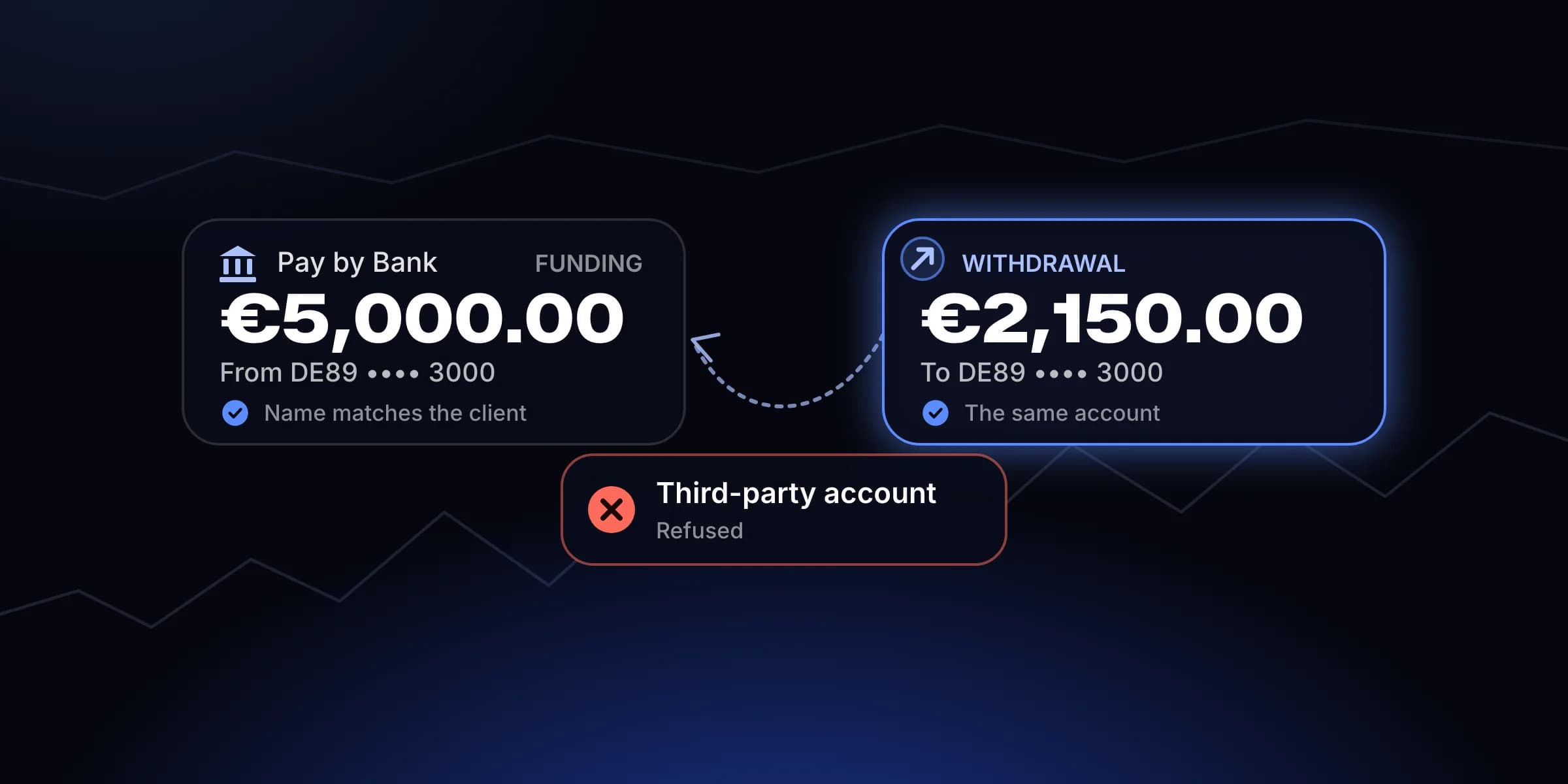
For declines caused by card issuer policy, the most effective recovery is often a different rail rather than a different acquirer. With Pay by Bank, the player approves the deposit in their own banking app. There is no card, so the card issuer’s view of MCC 7995 never comes into it, and the deposit is confirmed in seconds where the bank supports instant payments.
Two honest caveats. The player’s bank can still decline: insufficient funds, its own risk checks, and in some cases its own gambling controls apply to bank payments too. Published bank gambling blocks are mostly described as card blocks, but whether a given block also stops a bank payment depends on the bank.
And a gambling block the player set is a safer-gambling signal, not an obstacle to engineer around. Where your data tells you a player has blocked gambling on their card, or your own safer-gambling markers are raised, offering them another way to deposit works against the duty you hold under your licence. Use the fallback for declines that are about the card, not about the player.
The three numbers to track
You can’t manage declines from a single authorisation rate. Track these instead:
Authorisation rate by issuer country and card type (debit, credit, business). Gambling declines cluster by issuer. A drop at three banks tells you more than a drop overall.
Declines by category: never-retry, retry later, authentication, data, technical. This is the mix that decides what any fix can achieve.
Recovery rate on the fallback: of the deposits offered another route or method after a decline, how many completed.
Frequently asked questions
Why are gambling transactions declined so often?
Mostly because issuers treat the gambling merchant code, MCC 7995, as high risk and set their own policies for it, players can block gambling payments at their bank, and 3D Secure checks fail or get abandoned, often on phones. Insufficient funds and technical errors add to the total, as they do for any card payment.
What is MCC 7995?
MCC 7995 is the merchant category code for betting: casino gaming chips, lottery tickets, off-track betting and wagers. Online casinos and sportsbooks use it, so every card deposit tells the issuer it is a gambling payment. Visa treats card-absent gambling as its highest integrity risk tier, with extra controls on acquirers.
What is the difference between a soft and a hard decline?
A hard decline means the issuer will not approve the payment however often you try: lost or stolen cards, invalid numbers, transactions not permitted. A soft decline is temporary or fixable: insufficient funds, an issuer outage, or a request for 3D Secure. Visa formalises this in four categories; Mastercard uses merchant advice codes.
How many times can you retry a declined card payment?
Never after a hard decline. For other declines, Visa caps reattempts per card in a 30-day window: 15 in its 2020 rule change, reported by acquirers as 20 since May 2025. Mastercard’s advice codes tell you when to retry, from one hour to ten days. Excess attempts carry scheme fees.
Does Pay by Bank work when a card is blocked for gambling?
It avoids card issuer policies, because no card is involved: the player approves the payment in their banking app. It doesn’t override the player’s bank, which can still decline, and some bank gambling controls may cover bank payments too. A block the player chose for themselves should be respected, not routed around.
Where Sola fits
Sola adds Pay by Bank deposits to your cashier beside your existing cards, in euros, approved in the player’s own banking app across 3,000+ connected banks. Across the methods you turn on, each payment is scored on cost, the player’s country and bank, and recent success rates, then sent to the best available one: you set the priorities. You hold the licence for every market you take deposits in; we bring the rails. More on payments for iGaming operators and how our routing decides. For the compliance side of bank deposits, see open banking for online gambling, and for cost, Pay by Bank vs card payments.
Sources
Visa Integrity Risk Program, Visa, 6 April 2023
Updates to rules for declined transaction resubmission and use of authorisation response codes, Visa, 3 September 2020
Network response codes, Mastercard Developers
Delegated Regulation (EU) 2018/389, technical standards on strong customer authentication, EUR-Lex
How to block gambling transactions, UK Gambling Commission, updated 25 February 2025
Preventing credit card use, UK Gambling Commission
Raising the stakes: the Gambling Regulation Act commences, DLA Piper, 16 February 2026
Send us a month of decline codes
We'll show which deposits failed for reasons a bank payment avoids, and what they were worth, in writing.
Analyse my declines
NEWSLETTER
One email a month. No fluff.
New articles on Open Banking, card costs, routing and regulation — straight to your inbox. Unsubscribe in one click.