
BLOG · Industries
Marketplace payments explained: merchant of record, KYB and paying sellers
The ways a platform can take money for its sellers, why the commercial agent exclusion rarely covers a marketplace, what KYB asks, and how seller payouts really add up.
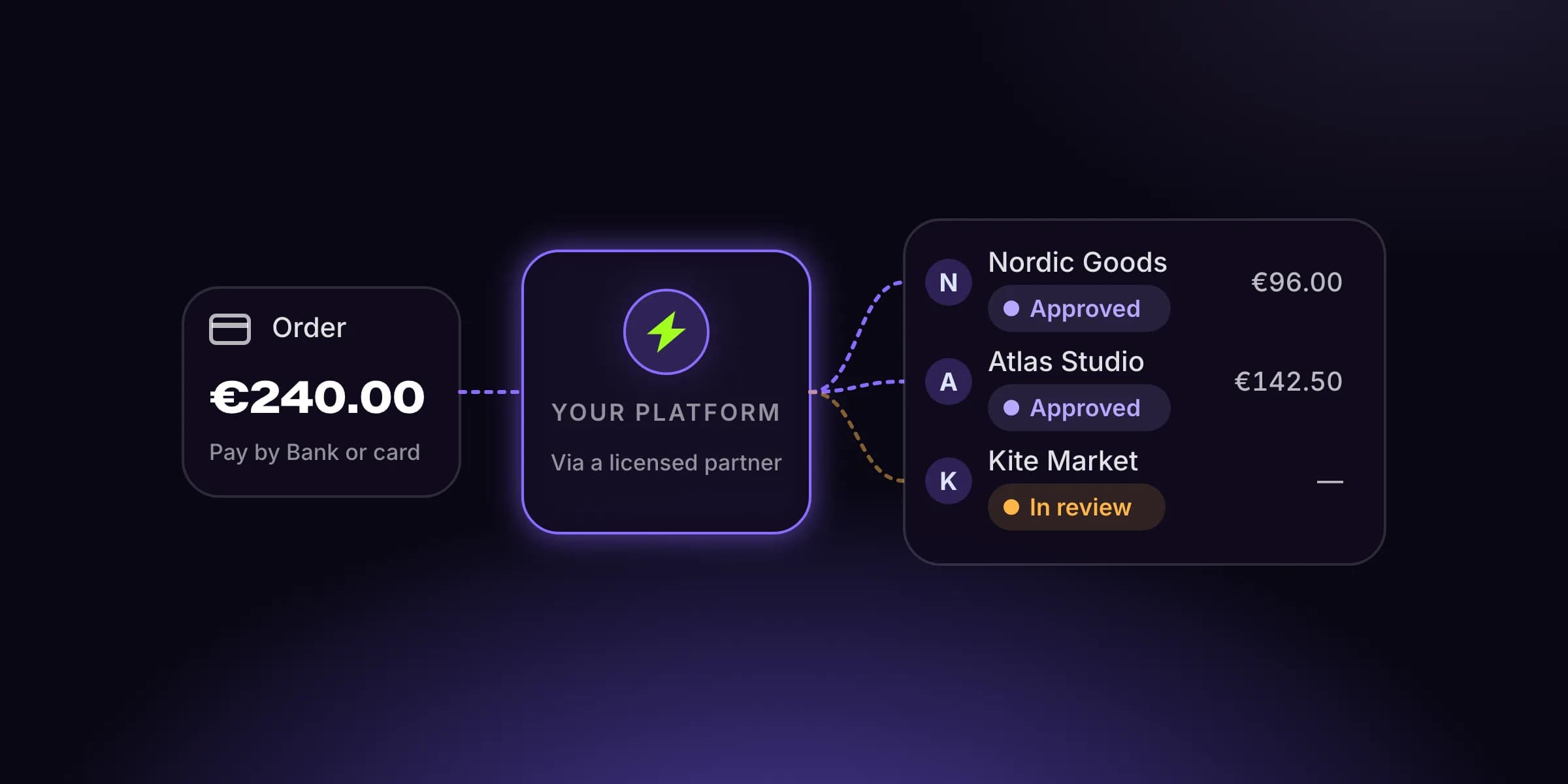
The moment your platform takes a buyer’s money and passes it on to a seller, you’re in the business of marketplace payments, and in Europe that brings payment services law with it. Many founders find this out late: after launch, when a bank asks who holds the money, or when a regulator asks why.
Short answer: a platform has three realistic ways to handle money. It can be the merchant of record and sell in its own name, rely on the commercial agent exclusion in the EU’s payment rules, or have a licensed payment institution hold and move the money for its sellers. For an open marketplace that acts for both buyers and sellers, the commercial agent exclusion rarely applies, which is why many end up with the third.
Three ways a platform can handle payments
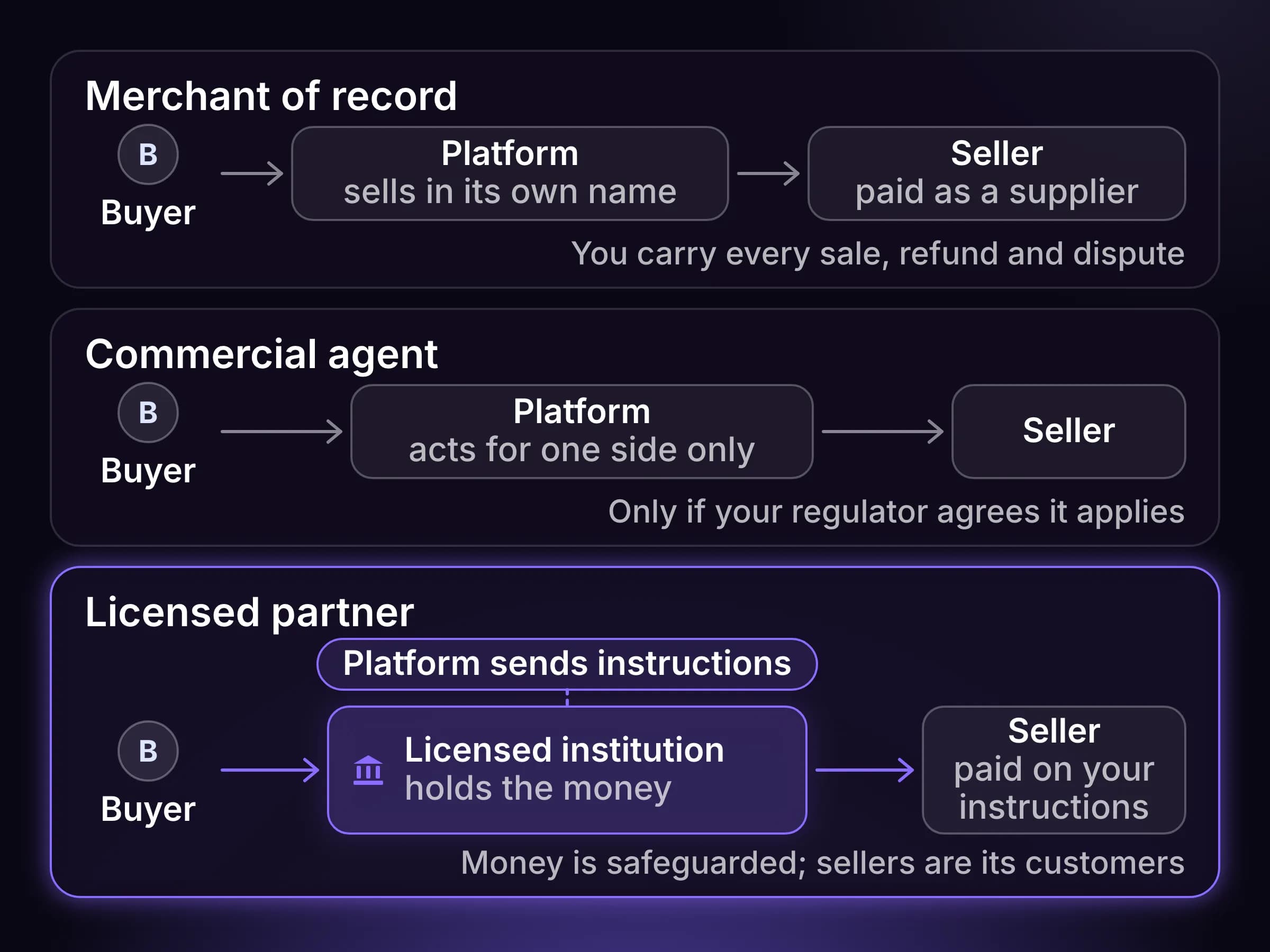
1. Be the merchant of record. You sell to the buyer in your own name, take the payment as your own revenue, and pay your sellers as your suppliers. It’s the classic retailer model. “Merchant of record” is a card scheme term rather than a legal one: Visa, for example, treats a registered marketplace as the merchant of record, financially liable for every dispute, not the underlying retailers. It works well for curated catalogues and gets heavy with thousands of independent sellers, because every sale, refund and dispute is yours.
2. Act as a commercial agent. EU payment services law excludes payments made through an agent who negotiates or concludes sales on behalf of only the buyer or only the seller. If your platform genuinely works for one side only, with real authority to negotiate for them, you may fall outside the licensing rules. Few open marketplaces fit, as the next section explains.
3. Let a licensed institution hold and move the money. Your sellers become customers, or sub-merchants, of a licensed payment or e-money institution. Buyer money is held there, safeguarded, and paid out to sellers on instructions your platform sends. Card schemes have their own version of this, the payment facilitator: a platform that signs up sellers on behalf of an acquirer and distributes their settlement, with the acquirer answerable for both.
A fourth path, getting your own payment institution licence, exists too. It suits platforms large enough to carry the capital, compliance team and supervision that come with it.
Why the commercial agent exclusion rarely covers a marketplace
The exclusion sits in Article 3(b) of PSD2, the EU payment services directive. It covers payments “through a commercial agent authorised via an agreement to negotiate or conclude the sale or purchase of goods or services on behalf of only the payer or only the payee”. Two words do the work: “only” and “authorised”. A marketplace that collects money from buyers and pays sellers usually serves both sides, and rarely has real authority to negotiate for either.
The authorities have said as much. In answers published by the European Banking Authority in December 2021, and prepared by the European Commission (non-binding, but a clear view of how regulators read the rule), a platform receiving payments on behalf of sellers “is not to be excluded by default”, and settling the buyer’s debt to the seller isn’t in itself a reason to exclude it. A business-to-consumer platform “could be excluded” if it acts for the seller only, but its regulator decides that case by case, and PSD2 gives no criteria for it. The Dutch central bank is blunter: a footnote in its guidance on sub-merchants says marketplaces and platforms that pay out money to sellers must hold a licence to do so.
It’s likely to get stricter. The final compromise text of the EU’s new Payment Services Regulation, dated 17 April 2026, keeps the exclusion for an agent acting “on behalf of only the payer or only the payee, but not both of them”, and adds that the agreement must give the agent “a real scope to negotiate”. It also asks the European Banking Authority for guidelines. The regulation was agreed politically in November 2025 and is still awaiting formal adoption, so it isn’t law yet, but the direction is clear.
KYB: what a licensed partner asks about each seller
Under the licensed-partner model, every seller is a business customer of the institution, and the institution has to know who it is: know your business (KYB). The exact list varies by institution and country, but it covers the same ground:
Who the seller is: the legal entity, its registration and address, from an official register.
Who owns and controls it: the beneficial owners. Under the EU’s anti-money-laundering directive, holding more than 25% is an indication of ownership, and member states can set a lower threshold. Access to the public registers of beneficial owners has been restricted since a 2022 ruling of the EU Court of Justice, so institutions often rely more on documents from the seller.
What it sells, and where. Some goods and services carry more risk, or need licences of their own.
Where its money goes: the account payouts will be sent to, in the seller’s own name.
Screening: sanctions lists and politically exposed persons.
Two things decide how painful this is for your sellers: whether the document list is known up front, and whether KYB status is visible to your platform, so you can chase what’s missing instead of waiting. The Dutch central bank’s good-practice paper also recommends ongoing monitoring per seller, not one profile for the whole platform. Running every seller through one account hides each seller’s behaviour inside the total.
Paying sellers: timing, reserves and refunds
The number a seller sees in their payout is rarely the number the buyer paid. Here is one week of a services marketplace, with every input an illustration rather than a benchmark:
Buyers pay 400 bookings at €75 | €30,000 |
Refunded in the week 3% of bookings, for illustration | −€900 |
Platform’s commission 15% of the €29,100 net, for illustration | −€4,365 |
Seller share Net sales after commission | €24,735 |
Held back as a reserve 5% of seller share, for illustration | −€1,237 |
Paid out to sellers this week | €23,498 |
The seller earned €24,735 but receives €23,498 this week, with the rest released later. Each of those lines needs a rule your sellers can read: when payouts run, which refunds come off which payout, how long a reserve is held and why.
Reserves exist mostly because of cards. A card payment can be disputed months after the seller has been paid, and someone has to cover a chargeback that arrives after the money has left. Refunds are cheaper and simpler before payout than after, which is why many platforms pay out on a delay. Payments that can’t be charged back change that arithmetic, which is where bank payments come in.
Pay by Bank on a marketplace
With Pay by Bank, the buyer approves the payment in their own banking app, and the money comes from their bank account rather than a card. For a marketplace, three things follow:
No chargeback scheme. It’s a push payment the buyer authorised, so there is nothing for an issuer to reverse months later, and no chargeback reserve to hold for those payments. Disputes go through the platform’s own process.
Lower costs on large baskets. There’s no card interchange in the payment, which matters most on high-value orders. We compare the two in detail in Pay by Bank vs card payments.
Confirmation in seconds where the buyer’s bank supports instant payments, so a booking or order can be confirmed while the buyer is still on the page.
With Sola, Pay by Bank runs in euros, and refunds on Pay by Bank payments are coming soon.
Many marketplaces add it beside cards rather than instead of them: cards for small, impulse purchases and buyers who want card protection, bank payments for larger orders.
Choosing a model
Merchant of record | Commercial agent | Licensed partner | Your own licence | |
|---|---|---|---|---|
Who sells to the buyer | You | The seller, through you | The seller | The seller |
Who holds buyer money | You, as your revenue | You, as agent | The licensed institution, safeguarded | You, safeguarded |
Payments licence needed | Not for the payments themselves | Only if the exclusion doesn’t apply, decided by your regulator | The partner’s | Your own |
Who carries card disputes | You | Depends on the set-up | Set by the contract | Depends on your acquiring contract |
Suits | Curated catalogues, few suppliers | Platforms that truly act for one side | Open marketplaces with many sellers | Very large platforms |
Tax is a separate question with its own answers: since July 2021, EU VAT rules can treat a marketplace as the deemed supplier for some sales of goods made through it, whichever payments model it uses.
Frequently asked questions
What is a merchant of record?
The merchant of record is the business that sells to the buyer in its own name and is responsible for the payment: its name is on the statement, and it carries refunds and disputes. It’s a card scheme and acquiring term rather than a legal one. A marketplace acting as merchant of record treats its sellers as suppliers.
Does a marketplace need a payment licence?
Often, if it holds buyers’ money and pays it on to sellers. The EU’s commercial agent exclusion covers only agents acting for one side, and the authorities say platforms aren’t excluded by default. Many platforms avoid needing their own licence by having a licensed institution hold and move the money. Check your model with your regulator or a lawyer.
What is the commercial agent exclusion?
It’s an exemption in Article 3(b) of PSD2 for payments made through an agent authorised to negotiate or conclude sales on behalf of only the buyer or only the seller. A platform acting for both sides is generally outside it. The new Payment Services Regulation, agreed but not yet adopted, would tighten it further.
What is KYB?
Know your business (KYB) is the set of checks a regulated institution runs on a business customer: who the company is, who owns and controls it, what it does, and where its money goes. On a marketplace that uses a licensed partner, every seller goes through KYB before it can be paid.
Where Sola fits
Sola works with marketplaces, payment providers and software platforms moving money that isn’t their own. We handle KYB per seller, with status you can surface in your own dashboard, and standard KYB clears in days. Onboarding sellers through the API is coming soon. Funds land per merchant account on the schedule you set, and limits or pauses apply to one seller, not the whole platform. Payouts to cards run today, and payouts to bank accounts are coming soon. Who is the merchant of record depends on your model and your permissions: we can run it either way, and we ask during onboarding, not after go-live. Payment services are provided by licensed partners. More on payments for platforms and marketplaces, payouts and the platform.
This article explains published rules and guidance. It isn’t legal advice: your model is for you and your regulator to assess.
Sources
Directive (EU) 2015/2366 on payment services (PSD2), Article 3(b) and recital 11, EUR-Lex, 25 November 2015
Q&A 2020_5354 on the commercial agent exclusion, European Banking Authority, 3 December 2021
Q&A 2020_5355 on the commercial agent exclusion, European Banking Authority, 6 December 2021
Payment Services Regulation, final compromise text (8221/26), Council of the EU, 17 April 2026
Procedure file 2023/0210(COD), European Parliament Legislative Observatory
Good practices: sub-merchants, De Nederlandsche Bank, 2023
Payment facilitator and marketplace risk guide, Visa, April 2021
Directive (EU) 2015/849 on anti-money laundering, Article 3(6), EUR-Lex
CJEU ruling on public access to beneficial ownership registers (C-37/20 and C-601/20), eucrim summary, 10 January 2023
VAT one-stop shop and deemed suppliers, European Commission
Visa’s payment facilitator model, Visa, 2024
Tell us your model
Describe how money moves on your platform today. We'll map the flows, the licences involved, and where Pay by Bank and cards fit.
Talk to our team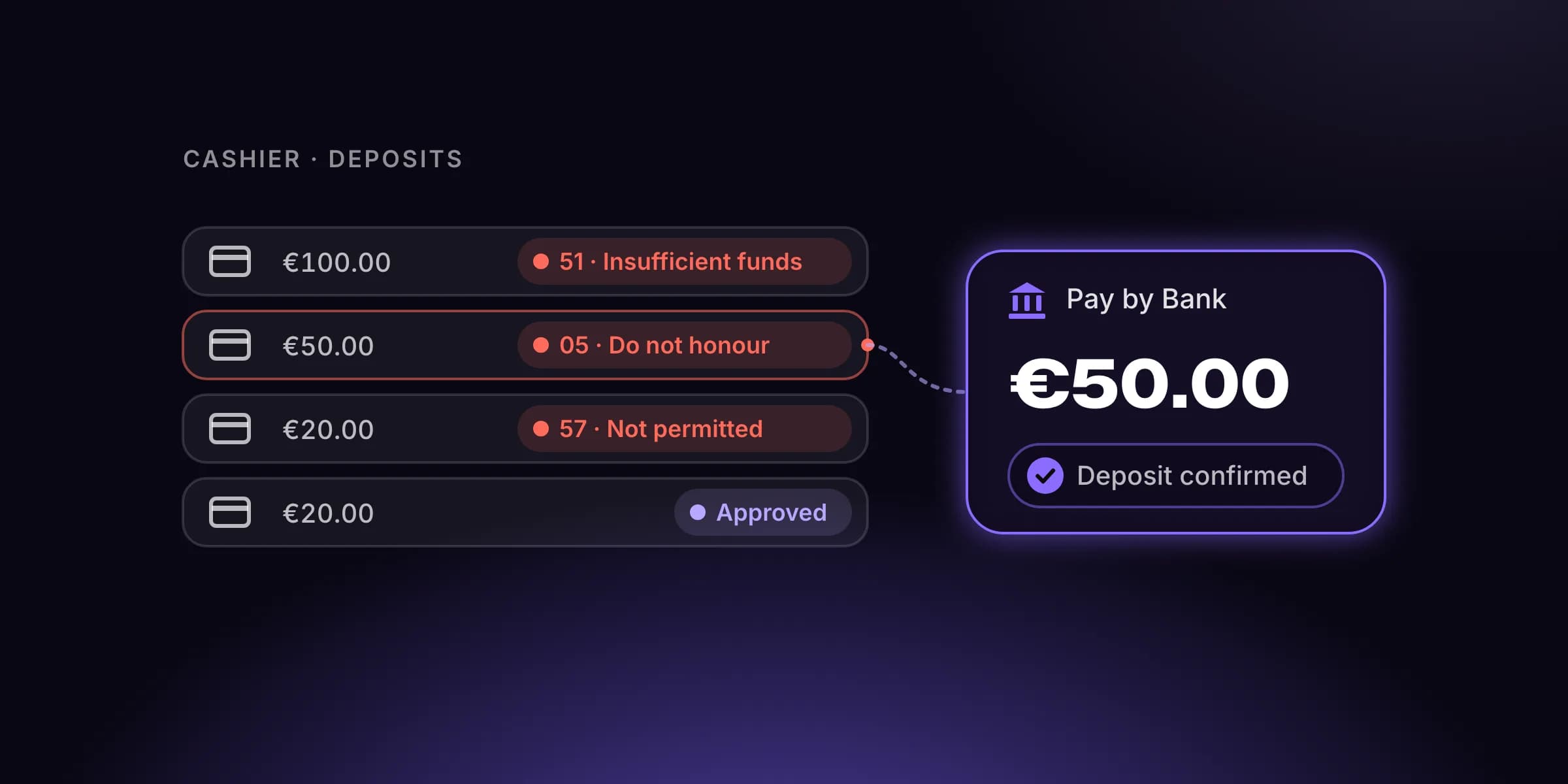
NEWSLETTER
One email a month. No fluff.
New articles on Open Banking, card costs, routing and regulation — straight to your inbox. Unsubscribe in one click.