
BLOG · Open Banking
Open banking for online gambling in Europe: deposits and player checks
What a bank payment changes for a licensed operator: deposits approved in the player's own bank, the account holder's name, deposit limits, exclusion registers, chargebacks and withdrawals.
Open banking in iGaming is usually sold as a faster deposit. That’s true, but for a licensed operator it isn’t the most interesting part. A bank payment comes from an account, approved by its holder in their own bank, and that changes what you can check about the player, what can be reversed afterwards, and how money gets back to them.
Short answer: with open banking, the player approves a deposit in their banking app and the money arrives from their bank account, in seconds where their bank supports instant payments. There is no chargeback scheme behind it, and the account the money comes from can support your checks that the player is who they say they are. It doesn’t replace your own duties. Deposit limits, exclusion registers and anti-money-laundering checks apply whatever rail the money arrives on.
How a Pay by Bank deposit works for a player
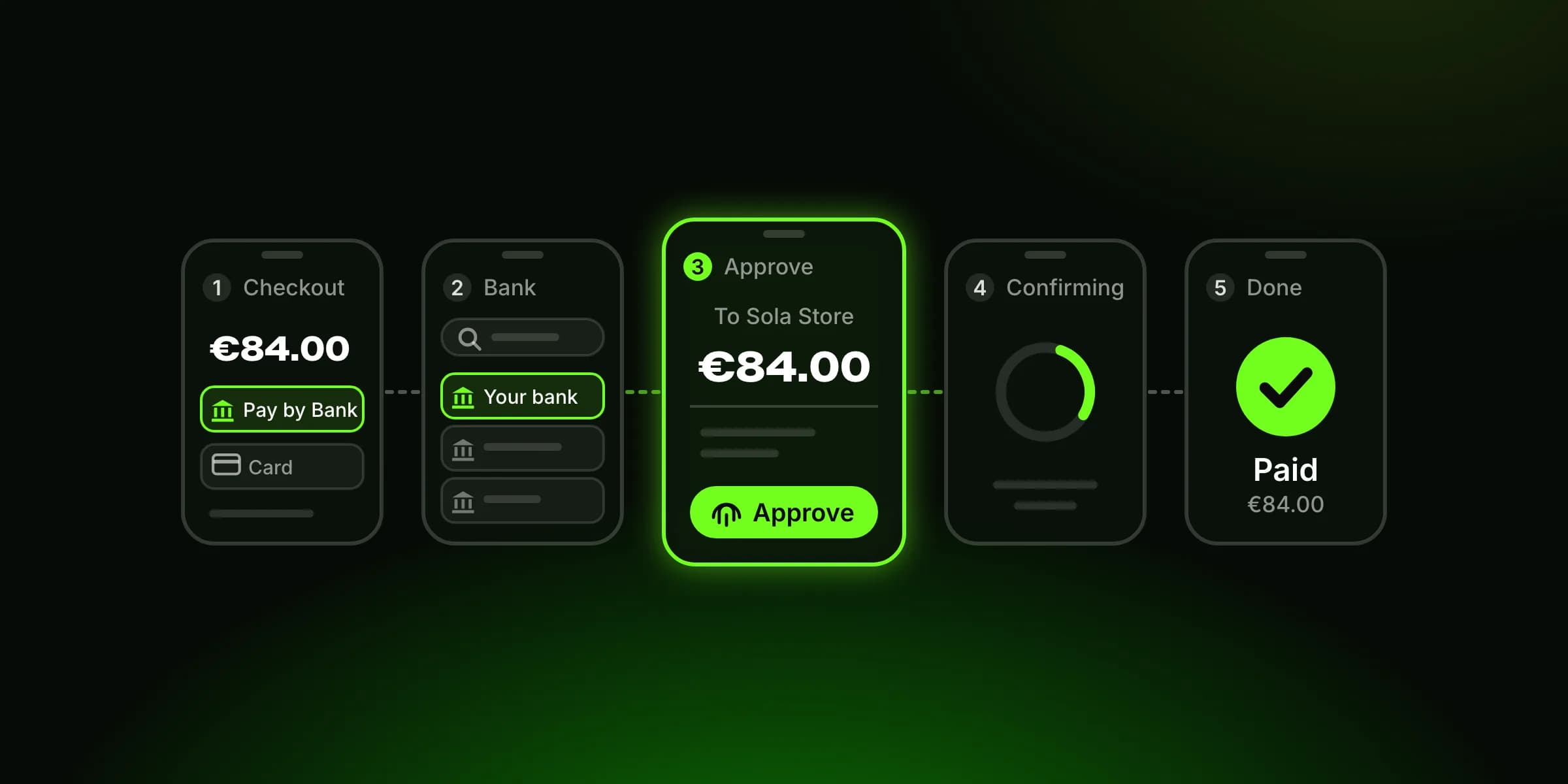
At your cashier the player chooses Pay by Bank, picks their bank, and is handed to their banking app. They approve the deposit there with a fingerprint, face or PIN, seeing the amount and who they’re paying, and come back to your site with the deposit confirmed. There’s no card number to type, and no card issuer to decide whether it likes gambling payments. Every step is in how Pay by Bank works.
Under the EU’s payment services rules, a payment the player has approved through a payment initiation provider can’t be revoked afterwards, and the money comes from the player’s own bank account.
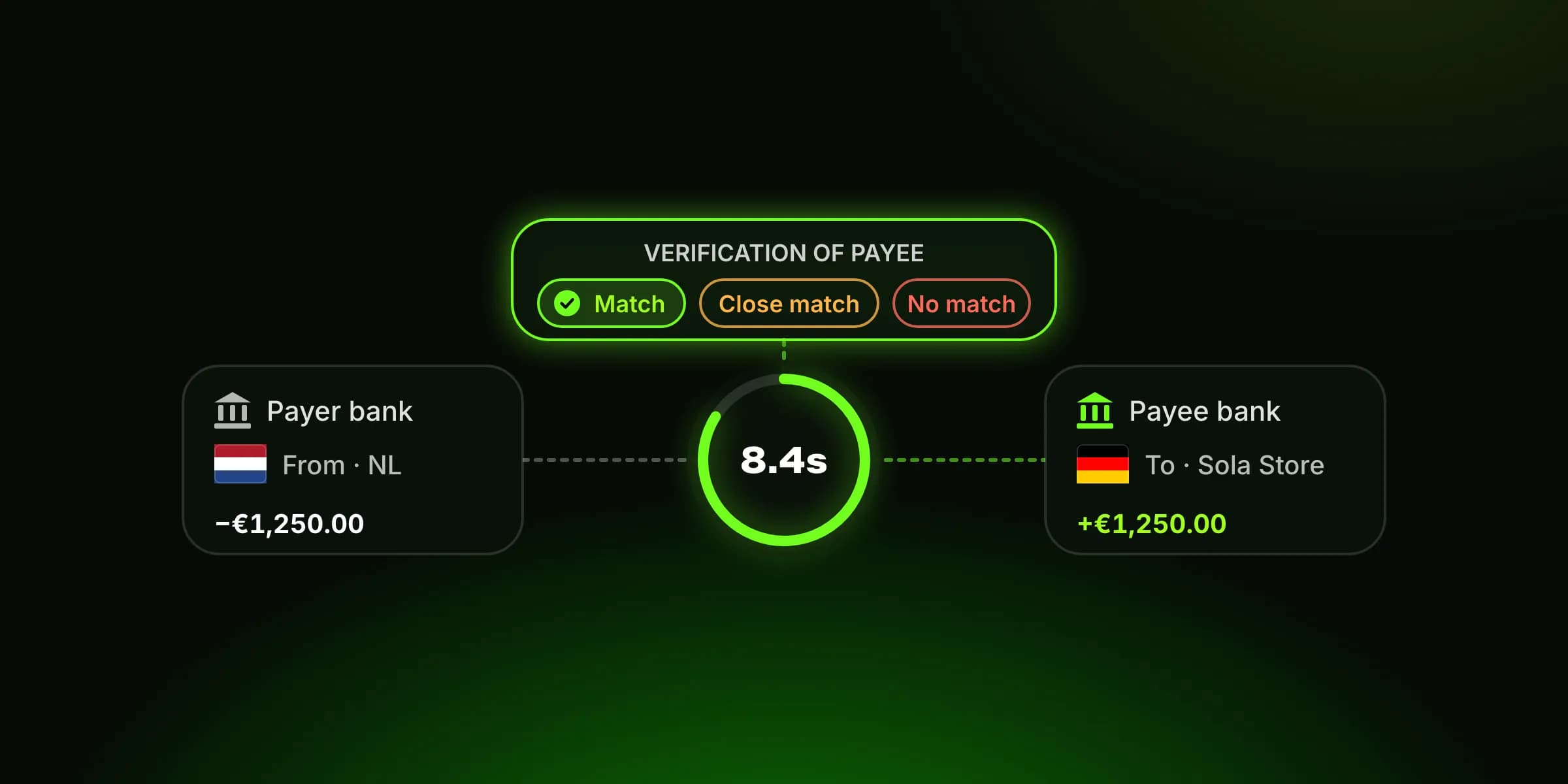
The account-holder name as a player check
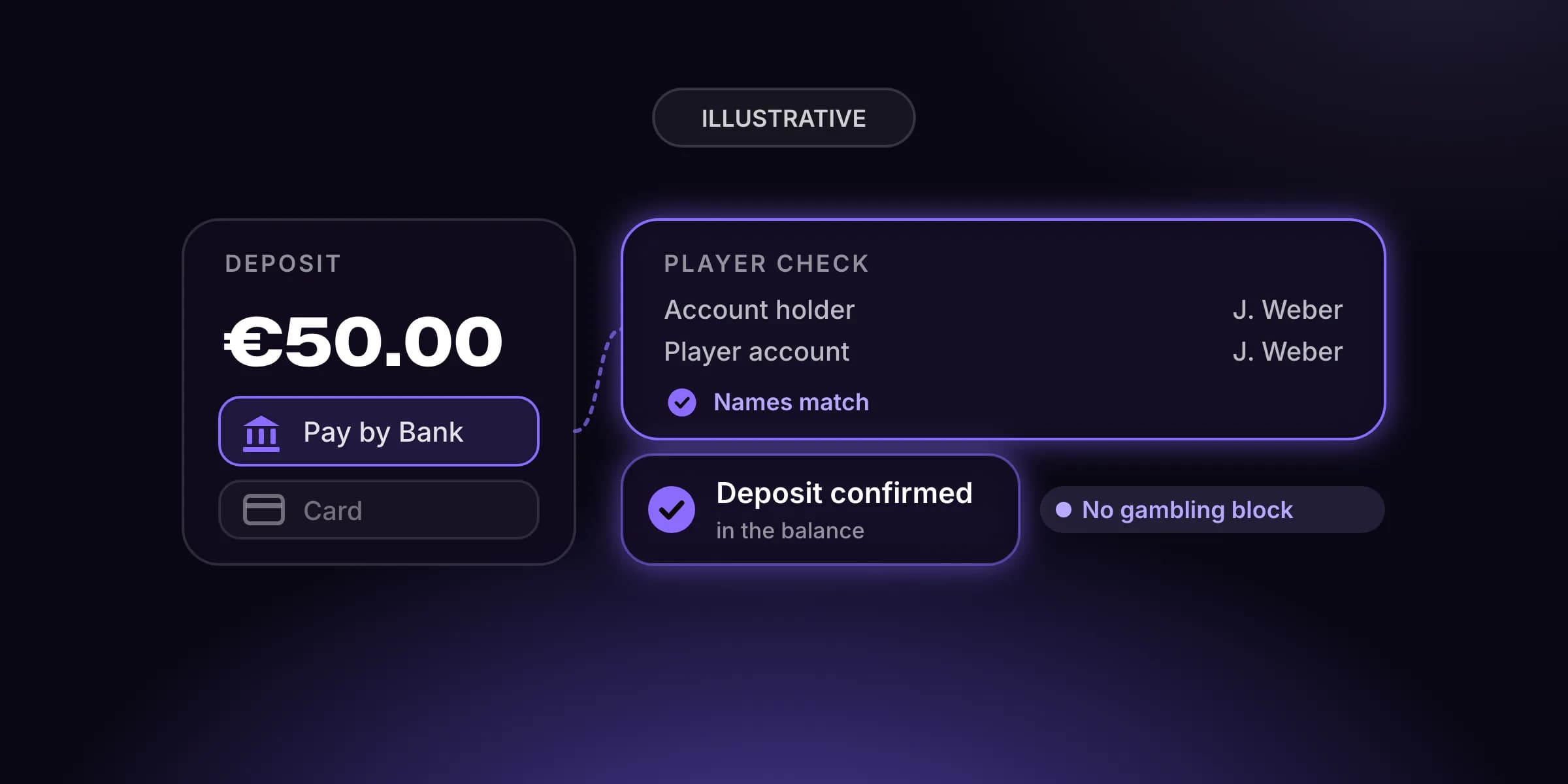
Regulators generally want deposits to come from the player, not from someone else’s account. The Netherlands puts it in writing. Under the Dutch remote gambling decree, an operator may credit a player’s gaming account only with money from an account in the player’s own name, traceable to that player. The explanatory note goes further: verifying the name of the account holder against the name on the player account “offers more certainty”, and the fact that the player can use a payment method isn’t enough. Germany’s gambling treaty contains no equivalent rule on the account name, but the same logic usually sits in an operator’s anti-money-laundering checks.
What does a bank payment actually tell you? Under PSD2, the player’s bank must give the payment provider the same information about the payment that it would show the player paying directly. Where the player picks the account in their bank, the European Banking Authority says the bank should report which account was used. The account holder’s name is commonly available too: the main European technical standard for these connections has a field for it, but it’s optional, and PSD2 doesn’t guarantee it for every bank.
So the honest version is this. Where the name comes back, you can compare it with the name you verified when the player signed up, and decide in advance how you treat joint accounts, married names and accented spellings. Where it doesn’t, you fall back on your usual checks. Account information services, the other half of open banking, can show more, such as balances and history for affordability checks, but they’re a separate service, with their own consent from the player.
Deposit limits by market
Limits are set per market, enforced by the operator, and they apply to bank deposits exactly as they do to cards. Two examples show how different they are.
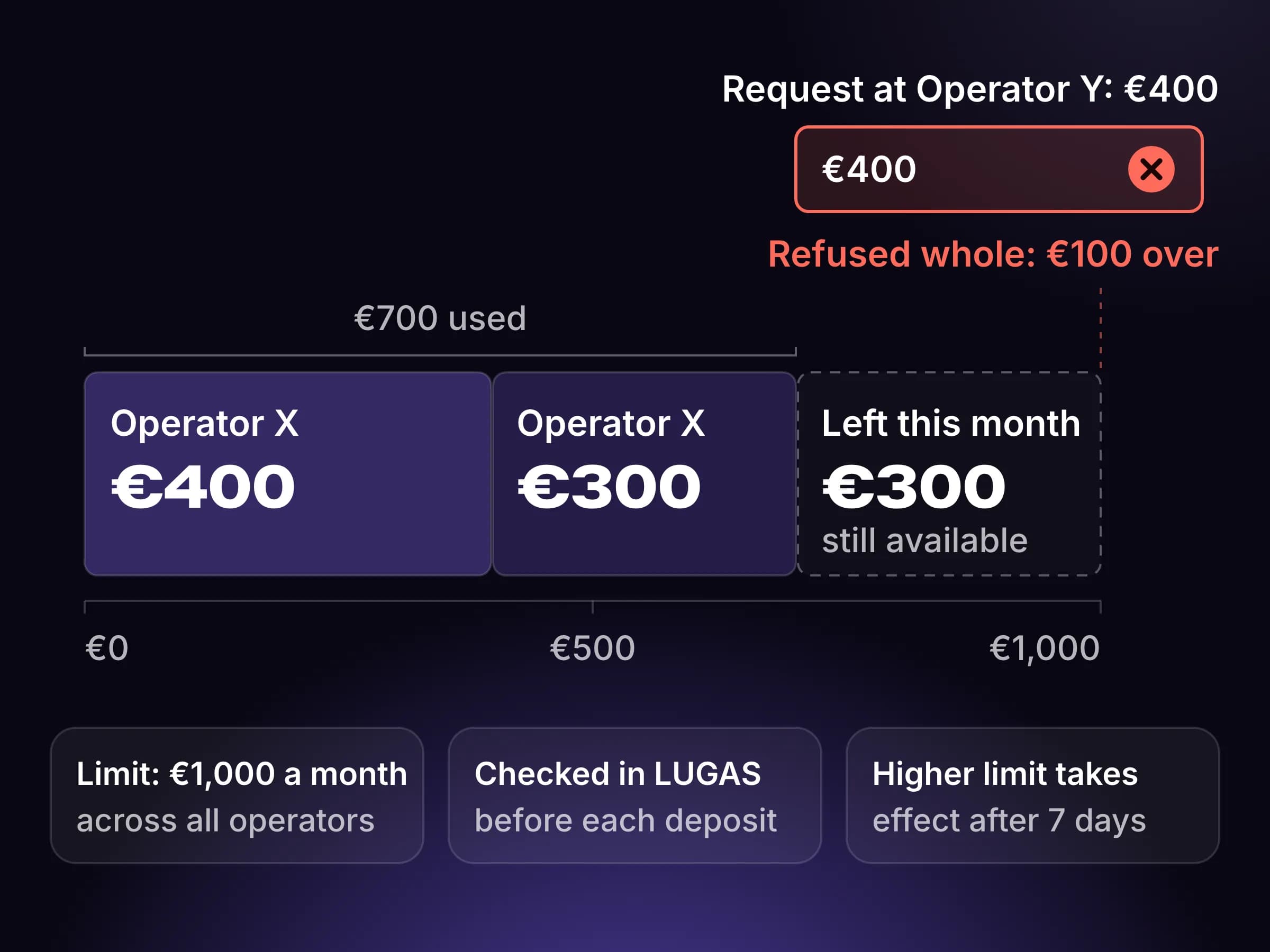
Germany. Under the State Treaty on Gambling 2021, every player must set a monthly deposit limit that applies across all licensed online operators, and it may not exceed €1,000 a month as a rule. Before each deposit, the operator checks the central limit file (LUGAS) with the player’s identity and the amount, and refuses what would go over. A player can lower their limit at once, but a higher one takes effect only after seven days. For 2026, the GGL regulator’s framework lets online casino operators accept higher limits: up to €10,000 with verifiable proof of the player’s finances, and up to €30,000 for no more than 1% of an operator’s active players.
Here is how the cross-operator limit plays out for one player in one month:
Monthly limit across all operators The default | €1,000 |
Deposited at operator X €400, then €300 | €700 |
Requested at operator Y One deposit | €400 |
Left of the limit Less than the request, so the deposit is refused | €300 |
Accepted at operator Y | €0 |
The treaty doesn’t allow a partial deposit: one that would go over the limit is refused whole. The player can try again with €300 or less, and that deposit is checked again.
The Netherlands. Since 1 October 2024, a new player can set a monthly deposit limit of at most €350 (€150 for players under 24) on their own, and has to contact the operator to go higher. Separately, the Dutch regulator expects an affordability check once a player’s net deposits in a month pass €700, or €300 for players aged 18 to 23, according to its own guidance. The regulator calls this threshold advice rather than law, but enforces it through operators’ duty of care. Until the check is done, deposits stop for the rest of the month.
None of this is the payment provider’s job, and a bank payment doesn’t change it. What changes is the data you can attach to each deposit.
Gambling blocks and self-exclusion
National exclusion registers sit with the operator. In Germany, operators must check the OASIS register before a player takes part; a self-exclusion lasts at least a year, though a player can ask for a shorter period of no less than three months. In the Netherlands, operators consult the CRUKS register before letting anyone play. A payment provider doesn’t check these registers, and can’t do it for you.
Banks add their own layer. Many let customers block gambling payments in their app, but published bank blocks are mostly described as card blocks, keyed to the gambling merchant code that card payments carry. Whether a block also stops a bank transfer to a gambling operator depends on the bank. Either way, a block a player set for themselves is a safer-gambling signal. A cashier that steers a blocked player from their card to their bank account works against your own duty of care.
Chargebacks, refunds and withdrawals
Chargebacks. A bank payment is a push payment the player authorised in their own bank. There’s no card scheme behind it, so there’s no chargeback. That ends a familiar problem for operators: a player who loses and then disputes the deposit with their card issuer. Players keep their rights for payments they didn’t authorise: under PSD2, their bank must refund an unauthorised payment by the end of the next business day. A payment they did authorise, even one they regret, isn’t covered.
Refunds and withdrawals. Anti-money-laundering practice expects money to go back where it came from. A player who deposited from a bank account should, ideally, be paid back to the same account. With Sola, payouts to cards run today, and payouts to bank accounts are coming soon.
Money-laundering checks. Gambling operators are obliged entities under the EU’s anti-money-laundering rules, and customer due diligence applies to transactions of €2,000 or more, whether single or linked. How deep source-of-funds checks go is a risk-based decision that doesn’t change with the payment rail, though a deposit from an account in the player’s own name gives those checks a firmer start. From 10 July 2027, the EU’s new Anti-Money Laundering Regulation (EU) 2024/1624 applies directly in every member state, alongside a new directive that replaces the current one.
What open banking doesn’t fix
It’s worth being clear about the limits, because vendors often aren’t:
Not every player can use it. It needs online banking at a connected bank, and some players simply prefer cards or wallets.
Not every payment is instant. Banks that send a standard transfer instead of an instant one leave the deposit pending, sometimes until the next business day.
The name isn’t always there. As above, the account holder’s name is common but not guaranteed.
Your duties don’t move. Limits, registers, affordability and anti-money-laundering checks stay with you.
It’s euro only, for now. With Sola, Pay by Bank runs in euros, and bank coverage varies by market, which is why most operators keep cards alongside.
Frequently asked questions
Can online casinos accept open banking payments?
Yes, licensed operators can accept deposits through Pay by Bank, where the player approves the payment in their own banking app. The usual gambling rules still apply: deposit limits, exclusion registers and anti-money-laundering checks are the operator’s responsibility, whatever the payment method.
Is Pay by Bank safe for gambling deposits?
The player approves each deposit inside their own banking app with strong customer authentication, and sees the amount and the payee before approving. The operator and the payment provider never see the player’s banking login. If a payment wasn’t authorised, PSD2 requires the player’s bank to refund it, normally by the next business day.
Do bank gambling blocks stop Pay by Bank deposits?
Sometimes. Most bank gambling blocks are described as card blocks, keyed to the gambling merchant code on card payments, and whether they also stop bank transfers depends on the bank. Operators should treat a player’s own block as a safer-gambling signal rather than something to route around.
Are there chargebacks on open banking deposits?
No. An open banking deposit is a push payment the player authorises in their own bank, so there is no card chargeback process behind it. The player can still claim a refund from their bank for a payment they didn’t authorise, under PSD2.
Where Sola fits
Sola adds Pay by Bank deposits to your cashier: the player approves in their own banking app, confirmed in seconds, with no card in the chain, across 3,000+ connected banks in euros. Cards and wallets stay alongside for markets where bank coverage is still thin. You hold the licence for every market you take deposits in, and we ask to see it during onboarding. Payouts to cards run today, and payouts to bank accounts are coming soon. More on payments for iGaming operators, on why card deposits get declined, and on Pay by Bank in Germany.
This article describes published rules. It isn’t legal advice: check each market’s current requirements with your regulator.
Sources
State Treaty on Gambling 2021, consolidated text, Gemeinsame Glücksspielbehörde der Länder, 2 September 2025
Framework for higher deposit limits in online casino games, GGL, 30 December 2025
Deposit limits and spending limits, Kansspelautoriteit
Binding instruction on the duty of care, Kansspelautoriteit, 22 January 2026
Decree on remote gambling, explanatory note (Stb. 2022, 299), Staatsblad, 14 July 2022
Directive (EU) 2015/2366 on payment services (PSD2), EUR-Lex
Opinion on obstacles under Article 32(3) of the RTS on SCA and CSC, European Banking Authority, 4 June 2020
Regulation (EU) 2024/1624, the EU anti-money-laundering regulation, EUR-Lex, applying from 10 July 2027
See it on your cashier
Send your deposit volumes by market. We'll show the cost difference and how bank deposits sit beside your cards.
Get a cost comparison
NEWSLETTER
One email a month. No fluff.
New articles on Open Banking, card costs, routing and regulation — straight to your inbox. Unsubscribe in one click.